
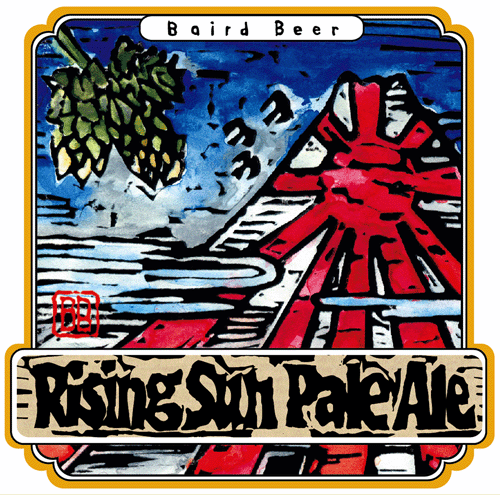
 Earlier this month during a trip to Japan, I traveled to the coastal city of Numazu to visit Baird Brewing Company, one of the country's most innovative new craft breweries. When I arrived, I had the fortune to meet Bryan and Sayuri Baird, who founded the brewery in 2000. Bryan answered some questions about brewing in Japan:
After graduating from Johns Hopkins SAIS, what inspired you to get into the brewing business and why Japan?
I attended SAIS in the Japan Studies program and enrolled with the full intent of returning to Japan in some professional capacity upon graduation. My first job was with the Tokyo office of the American Electronics Association. Craft beer, or ji-biiru as it was called, was receiving great attention in Japan at the time because it was a brand new thing—small-scale brewing was made possible with deregulation that happened during the Hosokawa government in which minimum production requirements necessary for a brewing license were lowered dramatically from 2000 kl per year to 60 kl. I didn't love working as a sarariman (salary man); I always had been a passionate beer drinker; and I respected Japanese society for the reverence it paid to craftsmanship. Therefore, I felt that craft beer was an industry that suited both me and Japan.
Why did you choose to locate your brewery in the city of Numazu?
After attending brewing school in California, my first industry job with a brewing equipment company brought me to Numazu. Our ultimate dream, of course, was to launch our own craft brewing company. For a variety of reasons, we judged Numazu to be a very good place to inaugurate a craft beer business. We thus stayed and here we still are today.
How did your initial brewing learning process take place?
The first thing I did, and the smartest, was to immediately enroll in brewing school. I attended the American Brewers Guild's 3-month intensive brewing science and engineering program, which also combined with a practical apprenticeship. My apprenticeship was done at the Redhook Brewery in Seattle. I thus had very good initial training. Being a good brewer, though, is very much dependent on the interplay of theoretical knowledge and practical experience. To gain more practical experience I cobbled together a tiny brewing system out of re-welded used kegs, set it up on our veranda and began brewing pilot batch after pilot batch. This was the actual system with which we launched our original brewery-pub. It was so tiny (30-liter batches) that I had to brew with great frequency and this helped me to accrue invaluable experience in a very short time.
Who were your inspirations?
My greatest business inspiration is Warren Buffet. The principles and values he espouses I embrace wholeheartedly.
Which breweries do you admire most?
Fritz Maytag of Anchor Brewing in San Francisco (although he just recently sold the business) and Ken Grossman of Sierre Nevada Brewing in Chico, California are probably my two biggest industry heroes. Some of my favorite breweries now include Russian River, Firestone Walker, and Victory. Piece Brewery and Pizzeria in Chicago and the Pelican Pub & Brewery in Oregon are two outstanding brewery-pubs.
What is your beer's concept?
With each and every Baird Beer we seek to craft a full-flavored beer of character. We define character simply: Character is the interplay of balance and complexity. Industrial beer tends to be well balanced (i.e. it can be drunk in quantity without inducing palate fatigue) but fully lacking in complexity (i.e. the flavor is one-dimensional and you pretty much know everything about the beer upon the first sip). Poorly made craft beer tends to be complex but it lacks balance. Great craft beer possesses both. For us, the key to achieving this character is minimal processing. Therefore, we begin by selecting ingredients that are minimally processed (e.g. traditional floor-malted barley, whole flower hops, fresh whole fruit, etc.). Then, we strive to brew with these ingredients in as simple and unprocessed a way as possible (e.g. we do not filter Baird Beer and we secondarily ferment and naturally carbonate it in the package from which it will be dispensed—much like Champagne).
How is the beer Japanese?
We enjoy lovely soft water in Numazu that really contributes a round and balanced house character to our beers. In the Japanese esthetic, harmonious balance is greatly prized. I think Baird Beer is a liquid embodiment of that Japanese esthetic value.
What were some of the initial challenges you overcame as a microbrewer in Japan?
Japanese ji-biiru (craft beer) boomed out of the gate in 1994 but was already turning into a bust by the time we were getting into it around 1997. There was, and still is, simply too much bad craft beer in Japan and not enough really good stuff. Thus, we had to overcome the largely negative image that the industry garnered for itself in its initial years. The other major challenge was simply that we were brewing a kind of beer that had never really existed in Japan before and people really didn't know what to make of it and us. The key to growing sales in a nascent market like craft beer in Japan is, in addition to great product, constant consumer education. The more that consumers understand about beer and about how and why we approach it the way we do, the more open they are to the experience. This sort of education, though, takes time and requires persistence.
Is it easier for a foreigner to introduce a revolutionary product like microbrewery beer to Japan?
That's a good question. My answer is yes, so long as it is the right foreigner. By "right" I mean someone who comprehensively understands Japan, who can deal with Japanese people with cultural, social and lingustic understanding, and who genuinely likes and respects Japan. This is the type of foreigner that places like Johns Hopkins SAIS help to nurture. When you are this type of foreigner you get to participate in Japanese society on a deep and meaningful level but without having to face the same sort and degree of social and cultural constrictions that the Japanese themselves must often deal with. This kind of social liberation can be turned into a very valuable business asset.
How did your business start to take off?
The initial turning point for our business happened 2–3 years into it when we realized there was a definite market for what we were brewing, only it wasn't in Numazu but rather in Tokyo. This led us to purchase larger brewing equipment and begin bottling and kegging our beer for distribution in the Tokyo market. The more we sold in Tokyo, the more frequently Tokyo beer enthusiasts would make the pilgrimage to our pub in Numazu. This eventually led us to open pubs in Tokyo itself. By doing well in Tokyo and selling throughout Japan, the local market then began to wake up. Finally, ten years into it, we seem to have gained real traction and achieved that magical sort of critical mass. Our three gold medals in the 2010 World Beer Cup certainly didn't hurt things either.
What is the current state of the Japanese big beer and microbrewery market?
The big industrial brewers in Japan are in for some dark years, I am afraid. The simple fact is the overall Japan beer market is shrinking. This is because the population is both aging and not growing. As one gets older, one drinks less. I would not want to be an industrial brewer in Japan. As for craft beer in Japan, there are still way too many sub-par players. These poor performers need to be weeded out and this is happening gradually.
What do you see for the future of beer in Japan?
For good Japan craft brewers, as well as importers of excellent world craft beers, I believe the future is bright. People seem to be wanting more quality if not more quantity, and there seems to be at least a partial movement away from purely mass-produced and mass-marketed goods to premium niche goods crafted by shokunin (artisans). Currently in Japan, craft beer does not account for even 1 percent of the overall beer market. U.S. craft beer, on the other hand, accounts for more than 4 percent of the U.S. market by volume and more than 7 percent by dollar. I can see Japan craft beer achieving similar numbers in the Japan beer market within the next 10–20 years.
What advice do you have for aspiring entrepreneurs in Japan?
My advice is quite simple: Possess abundant reserves of passion, persistence, perseverance, integrity, and guts. Also, possessing sufficient "Japan skill" is critical to succeeding in business in Japan. Frankly, these Japan skills take longer and are harder to acquire than most industry-specific skills. Most foreign business people who do not do well here fail because of insufficiency on the Japan skill front.


 Posts
Posts


