
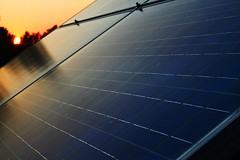
 Policy Innovations contributor Roy Morrison weighs in on alternative global warming solutions and related policies to finance them. He calls for a 20-year plan to transition to renewable resources:
The popular wisdom is that a global emissions reduction agreement through cap and trade or taxation is humanity's last best hope before the consequences of melting ice and methane hydrates make irrelevant further human efforts to stop global warming. If that's true, we are in grave danger indeed. We should instead focus on a workable global investment and jobs plan to build the global renewable resource infrastructure that can sustain global prosperity while slashing global greenhouse gas emissions.
The plan will draw upon existing and emergent renewable energy technologies. These technologies range from the now-familiar wind turbines, photovoltaic solar arrays, hydropower dams, and geothermal plants, to new solar concentrators and medium-temperature geothermal systems running organic Rankine cycle generators. These will be combined with electric and renewable-fueled hybrid vehicles using their lithium batteries for energy storage. Renewable systems are characterized by rapidly improving energy conversion efficiency and declining cost.
We should understand that the problem is not that we do not have sufficient renewable resources. This is a plan that will create millions and millions of new jobs and global markets for our products and at the same time free us from the fossil fuel curse and its economic, ecological, and security threats.
The plan for a renewable future is based not on imposing taxes on the unwilling or forcing everyone to eat celery. It's time to stop focusing our efforts on raising costs for polluters who are politically powerful and will fight us every step of the way. We can do without the higher taxes or complex cap and trade schemes that will further enrich Wall Street sharks and may not even work.
It's absolutely clear that markets with sharply fluctuating asset prices, whether for carbon credits or Renewable Energy Credits (RECs), do not provide sufficiently stable long-term cash flows to convince bankers and investors to risk trillions of dollars financing a sustainable future.
For example, I'm working on building solar farms in New Jersey. New Jersey, admirably, sets high regulatory alternative compliance payments (ACP) for energy suppliers that do not purchase solar RECs (SRECs) from solar developers. But since the actual price for those SRECs is determined by a bid-and-ask market with fluctuating prices, there is no working futures market for buying and selling large quantities of SRECs. Why stock up on SRECs now when prices could plunge, as they have for RECs around the country and for carbon in Europe?
Without a long-term SREC contract in hand, financiers will not invest hundreds of millions of dollars in solar farms. We are scrambling to negotiate deeply discounted long-term deals with electricity suppliers and designing our own innovative financial structures to get the financing to build our solar farms.
What works much better is the feed-in-tariff (FIT) used by Germany and now by Ontario. The Ontario Power Authority offers 20-year fixed price contracts, at different price levels, for various renewables, with the goal of ultimately eliminating the province's reliance on coal. You can take an approved design and a 20-year OPA contract to the bank.
If it's true that renewable resources can do the job, then why not put America on the path to its own 20-year plan? As renewable resources and a continental-scale renewable smart grid are phased in, fossil fuel resources will be phased out gradually. The oil and coal can be left in the ground, or sometimes used for chemical feedstock in accord with an industrial ecology of zero waste and zero pollution.
As we increase renewable resource use by a small percentage each year, natural gas can serve as the transition fuel. We don't even need to build the next generation of coal and nuclear plants and gas-guzzling automobiles. If it's politically necessary, we can pay the coal companies for mineral rights, much as we have paid farmers not to plant corn. And, of course, we could stretch the time frame out for 40 years to 2050. But why do that? The risks are too high to drag our feet, while the benefits of implementing a 20-year plan are enormous.
In 20 years, by 2030, fossil fuel power can be an artifact of a bygone era. Gasoline-powered engines would become a once-a-year treat at the county fair demolition derby. The daily news would be not about military deployments, but about surprising new trends in building an ecological civilization.
There's no reason to wait. Renewable resource construction is already moving ahead. It just needs a little more systematic push. Mechanisms we can rely on include:
Feed-in-Tariffs: We set goals for phasing in renewables and phasing out fossil fuels and nukes. We offer long-term contracts at prices sufficient to support investment given current capital costs and energy market prices. Most renewables have zero fuel cost, but high capital costs. Periodically, the price level of new FIT contracts are adjusted to keep up with changes in capital costs and market income as more renewables are phased in and the need for subsidies decreases. The FIT should be applicable to storage and efficiency projects as well as generation.
Continental-Scale Renewable Smart Grids: We transform the current regional power grid system into one capable of operating efficiently on a continental scale using High Voltage Direct Current (HVDC) power lines and smart controls. Such continental systems will be designed to optimize the balance between distributed local resources and system resources. Developing efficient and cheap local devices such as fuel cells, heat pumps, photovoltaics, batteries, flywheels, and capacitors means a potential major reduction in large scale "system" generation and storage resources needed to move large amounts of power over long distances.
Self-Equilibrating Systems: The system can be designed to operate in a substantially self-equilibrating and highly secure manner using cybernetic feedback loops. By equipping end-use devices and distributed generation with the ability to sense and respond to fluctuations in local voltage and frequency, the system can be substantially self-controlling, capable of operating in a regional fashion in the event of system disruption, and largely immune from cyber attack from malware and viruses since there will be few control signals to sabotage such as the current Automatic Generation Control (AGC) signals.
Clean Development: Development aid must be provided in sufficient quantities for poor and developing nations to make the transition. In countries without a national power grid, regional renewable resources with local storage and smart control can do the job. The approach must be global or it will fail. Global problems will require global solutions and cannot be accomplished upon the backs of the poor for the benefit of the rich.
This is a plan with winners and few losers. We build massive new non-polluting industries, and create millions of good-paying high-technology manufacturing, installation, computer control, and service jobs. In addition to transforming the economy, we free ourselves from the oil curse, the resource wars, and balance of payments nightmares. Cash will flow in from our customers instead of out to the sheikhs and oil barons. And we will lessen the threat from nations that wish to enrich uranium for "peaceful" purposes under the Non-Proliferation Treaty (NPT).
Today we face resolute opposition to anything more than marginal changes in emissions from such political and economic heavyweights as the global coal, oil, auto, and electric industries, and from major energy exporting and importing nations such as OPEC, Russia, China, and even the United States.
It's time to stop trying to plow a granite field. We can instead focus our efforts on an investment and job strategy that will build the renewable infrastructure and the powerful new industries that will be the basis not only for the prevention of climate catastrophe, but also for the development of prosperous and sustainable ecological future.
[PHOTO CREDIT: Photovoltaik, by Bernd Sieker (CC).]


 Posts
Posts


