Showing posts with label renewable energy. Show all posts

Wednesday, June 15, 2011

WindMade Public Comment Period Opens

I recently biked 300 miles over five days from New York City to Washington, D.C. as part of the Climate Ride, a semiannual charity event that raises money for bicycle and environmental organizations. My primary motivation in riding all the way to Capitol Hill (with 120 bright people from the sustainability sector) was the opportunity to meet with legislators to discuss climate change, clean energy, and transportation policy.

Vested interests in the coal, oil, and gas industry would likely characterize such a voyage as quixotic, and they would be correct in one sense: I saw some windmills along the way, each one representing a different phase in America's energy history—Past, Future, and Present.

Windmill 1: The first type of windmill I encountered was actually a windpump. The old beast was motionless and looked something like this:


Alexis Madrigal of The Atlantic has a great chapter in his book, Powering the Dream: The History and Promise of Green Technology, on how innovative businesses and American DIY culture combined to dot the Great Plains with these pumps, making settlement and agriculture possible in arid regions. The technology is still incredibly useful, but it symbolizes the Past.

Windmill 2: The second creature I spied was perched on an Amish rooftop, spinning madly, and looked a bit like this sleek species:


As Kevin Kelly notes in his tome What Technology Wants, the Amish are not adverse to technology as long as it doesn't distort their cultural ethics. They even have social procedures for testing and evaluating new devices, and abandoning them if they are deemed inappropriate. Small modern wind turbines thus symbolize a possible energy Future where innovation is encouraged.

Windmill 3: Finally, I encountered this monster in Morgantown, PA:


I didn't go rooting through the restaurant's trash to find its electricity bill, but the probability is high that this decorative windmill is powered mostly by dirty coal, as Pennsylvania represents 5.3 percent of America's annual coal consumption. This windmill symbolizes the profligate Present.

I bring this up because a consortium of partners has just launched an innovative initiative to label organizations and products as "WindMade." It is a new chapter in what my colleague Michael Conroy calls the certification revolution, one of the primary forces driving branded companies to improve their environmental, social, and governance indicators. It also builds on the legacy of other "trustmarks" such as Fair Trade, Organic, Forest Stewardship, and Marine Stewardship.

In order to qualify for WindMade certification an organization will have to prove that it is getting at least 25 percent of its electricity from wind power. This can be accomplished via on-site turbines, long-term power purchase agreements, and renewable energy credits. The WindMade standard will roll out later this year, starting with certification of whole organizations and specific locations such as factories, while phase two will expand the process to include product certification.

In an innovative crowd-sourcing move, WindMade has opened up its technical standard for a 60-day public comment period to solicit feedback and advice on how it can be improved.

The primary sponsor of this project is the Danish wind company Vestas, the world's leading turbine manufacturer. Vestas has agreed to fund WindMade as an independent nonprofit for its first three years, and going forward support is expected from all partners as well as the participating companies. When asked at a press briefing whether compliance costs would discourage adoption, Vestas representative Bragi Fjalldal indicated that the expense would be "negligible," especially for carbon-conscious companies that are already monitoring emissions.

Bloomberg is the data partner in this endeavor, providing market research, and Curtis Ravenel of their sustainability group estimated that some 100 companies would already qualify at the 25 percent level.

Clearly Vestas has a business interest in promoting wind power through a labeling system, but they also recognize that wind will never provide all of the world's energy needs. For this reason an alternate WindMade label will be available to companies that want to express the mix of energy they receive from wind, hydro, solar, and geothermal sources.

Another key stakeholder and participant in the WindMade process is WWF. According to Stephan Singer of their global energy policy division, climate change is the single gravest threat to species worldwide, which is why WWF has made the case that it is possible and necessary to achieve 100 percent renewable energy by 2050.

Another positive aspect of the WindMade project is that it intends to aid renewable energy deployment in the developing world. The exact details have yet to be determined, but Angelika Pullen of the Global Wind Energy Council said the following:
WindMade is a global initiative and will reach out to companies in other significant markets such as India, China, and Brazil in the public consultation process to determine how emerging markets and developing countries can best be included in the program. Overall, WindMade strives to make an impact beyond countries where wind energy is well established. It is our intention to raise funds to catalyze wind power projects in countries with less developed renewable energy infrastructure. This is a longer-term goal, however, so the details of how this will be operationalized are still under development.

Complaints about wind being an intermittent power source always strike me as odd, as if that's somehow a fundamentally worse problem than global warming or gyrations in the oil market. The greatest inconsistency I see has been in U.S. policy, which periodically allows wind investment incentives to lapse.

Whether climate change is to blame or not, the world is getting windier, and perhaps this will accelerate construction of offshore installations, which should be competitive with natural gas within the decade. Solar, too, is approaching or has reached grid parity in the sunniest locations.

With its potential to incentivize the growth of renewable energy—which is far from certain at this early stage, given the somewhat "mythical" nature of the ethical consumer—the WindMade label is an innovation that deserves the old "Amish" test run, and early adopters will likely reap a reputational benefit. The success of the program depends upon a strong and transparent technical standard immune from greenwash, which is what makes the public comment period so important. If you have your two cents, now is the time to deposit them.

Wednesday, May 4, 2011

Climate Challenge, or How I Learned to Start Pandering and Love the Pork

I played the Climate Challenge game recently after discovering it on the Games for Change website and found it to be a provocative look at the politics and policy solutions related to global warming. While the gameplay has a few blind spots (mainly the lack of good feedback on economic performance) and gets a bit repetitive, Climate Challenge communicates and encourages reflection on some important and perennial political lessons.

The gist is that you "play as the President of Europe from 2000 to 2100 [!?], and attempt to reduce your carbon emissions while maintaining vital national services and remaining popular with the electorate." This is tougher than it seems. There are five variables you must monitor—finances, energy, food, water, and emissions—and five policy areas with which to affect these variables—national, trade, agriculture & industry, local, and household. You are evaluated at the end of your public service on indicators of environment, wealth, and popularity.

For my first attempt I figured why not go for broke with an aggressive Green platform: I ended up getting booted out of office after four rounds. My approval rating fell through the floor when I neglected the food supply and the water infrastructure in favor of fuel taxes and rapid expansion of renewable energy, and my administration was punished by climate-induced floods and heat waves that further compounded my popularity problems. Game Over. Chalk it up to the game's learning curve.

Periodically during Climate Challenge, Europe must engage in environmental diplomacy with the other blocs: North America, South America, Africa, South Asia, Pacifica, and North Asia. The negotiation stage is minimal and it's not clear what's at stake, but you have the option to subsidize green development in each region. Presumably these gestures rally the negotiators to your side. But what is your side? While emissions targets give you something to aim for, they also make your job harder.

On my second pass I tried to be a more sensitive leader while still negotiating in good faith for emissions reductions on the international stage. Fortunately the game is loaded with great policy choices with which to meet these goals—energy innovation and efficiency, transportation and green building regulations, and investments in basic research.

I found that one way to keep my rating high was to focus on subsidizing things people wanted, like home solar, and to steer clear of things they didn't, such as carbon taxes—promote, don't restrict—which seems to adhere to what Roger Pielke calls his "iron law" of climate politics.

Climate Challenge also offers some tempting public programs of uncertain value (within the game environment): launch a space program, host the Olympics, send foreign aid. These tend to hemorrhage money, energy, and emissions, but the voters like them.

I played a final round with an exaggerated pro-business approach, funding things like nuclear projects and carbon capture, yet even then I somehow managed to throw the economy into hyperinflation by 2100 and allow criminals to stalk the streets. Clearly the game needs better feedback on the socioeconomic front, as my approval rating ran high throughout.

While the gameplay is just a bunch of clicking, the real action happens on the conceptual level, and there are some nice contextual touches that teach the reality of nimbyism, resource limitations, and political trade-offs. For example, after each election you get a newspaper report on how your policies have been received. My favorite one said: "The most popular policy was 'Spin your policies.'" A few dollars spent on savvy PR can go a long way.

Tuesday, March 22, 2011

Fukushima and the Fragility of Modern Civilization

As a companion piece to an on-the-ground account of the Japanese earthquake we published last week, I am posting here some thoughts from our colleague Peter David Pedersen of the Tokyo sustainability consultancy E-Square Inc. He reflects on the longer-term consequences of how Japan (and the rest of the world) will change behaviors related to potentially dangerous energy sources such as nuclear power. Peter has had personal experience with censorship in the Japanese media when it comes to criticizing TEPCO specifically and nuclear power in general.

Ogoto-onsen, near Kyoto, March 18, 2011

I am writing to you from a hotel along the shore of Biwa-ko, Japan's largest lake, some 528 km west (and slightly south) of the Fukushima nuclear power station. Fresh snow is covering the landscape in what would normally be a very idyllic setting.

Right now it feels absolutely surreal, as if all the earthquake destruction in eastern Japan combined with the man-made specter of nuclear destruction were scenes out a Hollywood movie entitled "Twin Disasters." But this is no movie, and whether there will be any form of "happy" ending to the nuclear malaise remains entirely unpredictable.

The Japanese government "cannot" talk openly and honestly to the Japanese public about the potential dangers in a worst-case scenario at Fukushima, primarily because of fears of panic among the 30 million people in the world's largest metropolitan area, Tokyo and Yokohama.

Over the last 10 years or so, I have repeatedly experienced the attempts of TEPCO (Tokyo Electric Power Co.) to control information on nuclear power in this country. For eighteen months, from 2000–2001, I anchored the main news program at MX TV, Tokyo's local TV station, and was told by the producer that "since TEPCO is a sponsor of our program, I would prefer if you do not openly criticize nuclear power."

On another occasion, I was writing a piece for a well-known publication for 5th and 6th grade school kids on the environment. That time the chief editor told me, "TEPCO is one of the sponsors of our magazine. While I would like you to write on the environment, please don't be critical of nuclear power."

On a third occasion, not directly related to TEPCO, I was interviewed by the Yomiuri newspaper, one of Japan's top two newspapers in terms of circulation, about the 1978 demonstrations throughout Denmark against the possible introduction of nuclear power, in which I participated as a child. When the interview appeared in the newspaper, my phrase "demonstrations against nuclear power" had been altered to "demonstrations for renewable energy." This was not what I had said, and when I called the journalist in charge, he sheepishly apologized, saying, "I did not dare to write anything negative about nuclear power lest I should invite the wrath of my editor (boss)."

I feel so very sorry for the people who are, right now, sacrificing their future health, and some of them their immediate lives, working to stop the disaster at the Fukushima Daiichi Nuclear Power Station. They may be described as "heroes"—and surely their efforts as such are heroic—but in a wider perspective they are victims of an industry in which the brainwashing of contractors and workers to believe that what they work with is safe has been pervasive.

In its entirety, the present situation in eastern Japan and the Tokyo metropolitan area has revealed the amazing fragility of modern civilization. All lifelines—water, transport, electricity, food supplies—have been severed or disrupted in eastern Japan, and Tokyo, one of the world's largest cities, was in danger of a large-scale, sudden blackout yesterday afternoon (March 17) as a cold spell of weather drove up electricity consumption close to the limit of maximum supply.

A good friend of mine, working at Tohoku University not far from the epicenter of the earthquake, called to tell how he finally, after six days, managed to leave Sendai (a city of more than 1 million on Honshu's east coast), driving to Tokyo in a 16-hour ordeal. No gasoline being available anywhere on the route, he barely managed to reach Tokyo, his gas tank drying up. More frightening than the drive, though, was how food and water were virtually impossible to obtain in the city center of Sendai.

"Emergency supplies have been distributed to the schools where tens of thousands of people take refuge, but nothing seemed to reach the city of Sendai and shelves in supermarkets were almost completely empty. For the first time, I had the feeling of a threat to my life because of an inability to buy food," he told me.

My friend made it, but older and weaker people are dying—or will die—as the crucial lifelines of a hypermodern society have been devastated.

The question, obviously, is what we can learn from this experience, not only in Japan but also in modern society as a whole. It remains to be seen whether we will truly learn anything at all. To me, there seem to be at least three major lessons. The first is the question of how or if lifestyles and values will change. The thing that the Japanese have been praised for throughout the first week of this terrible disaster has not been "technology" or "financial strength"—it has been the strong spirit, the patience, and the human qualities of the people here that have touched many around the world.

Money and shiny goods in temples of consumption have carried absolutely no value for the people here in the last week. Is there a chance that we may, now, see and act on the emptiness of useless consumerism? I hope there is a chance, although I do at the same time fear that once things settle down, Japan and the world will go on as if nothing had happened.

The second lesson is the danger of concentration of population into huge metropolises. Although the epicenter of the M9.0 earthquake was hundreds of kilometers northeast of Tokyo, the city was paralyzed, streets were clogged, subways inoperative, and phone lines dead. The staff at my office could not get home or get in touch with their family.

What if—and this could happen any day—the earthquake had hit Tokyo straight on? I have not the courage to think of the scale of disaster or the number of human lives that would have been lost. As urbanization continues at great speed in the world's population centers, the utter fragility of the 21st century megacity poses serious questions. Is there a way to answer this question in a more humane and sustainable manner than we are experiencing today? There must be.

The third lesson is the folly of making ourselves dependent on energy production from large-scale and extremely dangerous power stations, where no workable plans exist to control worst-case scenarios. Huge costs will be incurred in Japan over the next several decades to clean up Fukushima. Huge costs were incurred to build the plant in the first place. Surely this money could have been used more wisely. Hopefully, the lesson taken from Fukushima will, finally, make the idea of nonviolent, nontoxic, decentralized energy sources the mainstream policy and business choice around the world.

If we can learn the lessons, there is hope for the future.

Peter David Pedersen
Chief Executive
E-Square Inc.
Tokyo, JAPAN

[PHOTO CREDIT: Globovisión. Damaged reactor at Fukushima (CC).]

Wednesday, July 14, 2010

A Renewable Super-Grid for Europe?

I encourage you to read this interesting interview with German energy analyst Gregor Czisch on the potential for a cost-neutral renewable super-grid linking Europe and North Africa. I've selected a few key quotes here highlighting the policy and geopolitical concerns.

GEOPOLITICS / ENERGY SECURITY
The gas pipelines currently in use act exactly like a super-grid, transporting gas from Sahara and from Siberia to Europe. There is no conceptual difference from transmitting electricity instead of gas.
...
The scenario with renewable electricity would be instead much more secure, because the sources can be diversified, with less dependency from single countries.
If we look at the recent Copenhagen debates: instead of developing new ideas, they are still discussing about the trading of CO2 emissions, carbon limits, carbon-taxes and other old-style proposals which hardly are effective because they are too much based on the unrealistic believe [sic] in the positive market forces and neglect the inelastic behavior of the consumers in the case of energy consumption.

POLICY HARMONIZATION
We further need a harmonized regulation to support the financing of these projects, for example a common European feed-in tariff able to cover the cost for production and transmission of the electricity.

BENEFITS FOR NORTH AFRICA
To import 10% of its electricity demand from wind energy in Morocco, Europe would have to invest about 3% of its GDP in wind generators in Morocco. This corresponds to roughly 200% of the Moroccan GDP. Such a decision would boost the local economy, creating jobs, local competences and industries.
It would be a clear sign towards a systematical change in the way we live together, because it would not be a fragmented intervention or a temporary help for a developing country, but a sustainable investment in order to serve for a mutual interest in the long term.

Wednesday, December 16, 2009

Plan for a Renewable Future

Policy Innovations contributor Roy Morrison weighs in on alternative global warming solutions and related policies to finance them. He calls for a 20-year plan to transition to renewable resources:

The popular wisdom is that a global emissions reduction agreement through cap and trade or taxation is humanity's last best hope before the consequences of melting ice and methane hydrates make irrelevant further human efforts to stop global warming. If that's true, we are in grave danger indeed. We should instead focus on a workable global investment and jobs plan to build the global renewable resource infrastructure that can sustain global prosperity while slashing global greenhouse gas emissions.

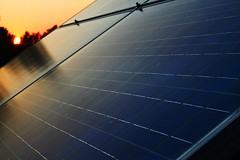
The plan will draw upon existing and emergent renewable energy technologies. These technologies range from the now-familiar wind turbines, photovoltaic solar arrays, hydropower dams, and geothermal plants, to new solar concentrators and medium-temperature geothermal systems running organic Rankine cycle generators. These will be combined with electric and renewable-fueled hybrid vehicles using their lithium batteries for energy storage. Renewable systems are characterized by rapidly improving energy conversion efficiency and declining cost.

We should understand that the problem is not that we do not have sufficient renewable resources. This is a plan that will create millions and millions of new jobs and global markets for our products and at the same time free us from the fossil fuel curse and its economic, ecological, and security threats.

The plan for a renewable future is based not on imposing taxes on the unwilling or forcing everyone to eat celery. It's time to stop focusing our efforts on raising costs for polluters who are politically powerful and will fight us every step of the way. We can do without the higher taxes or complex cap and trade schemes that will further enrich Wall Street sharks and may not even work.

It's absolutely clear that markets with sharply fluctuating asset prices, whether for carbon credits or Renewable Energy Credits (RECs), do not provide sufficiently stable long-term cash flows to convince bankers and investors to risk trillions of dollars financing a sustainable future.

For example, I'm working on building solar farms in New Jersey. New Jersey, admirably, sets high regulatory alternative compliance payments (ACP) for energy suppliers that do not purchase solar RECs (SRECs) from solar developers. But since the actual price for those SRECs is determined by a bid-and-ask market with fluctuating prices, there is no working futures market for buying and selling large quantities of SRECs. Why stock up on SRECs now when prices could plunge, as they have for RECs around the country and for carbon in Europe?

Without a long-term SREC contract in hand, financiers will not invest hundreds of millions of dollars in solar farms. We are scrambling to negotiate deeply discounted long-term deals with electricity suppliers and designing our own innovative financial structures to get the financing to build our solar farms.

What works much better is the feed-in-tariff (FIT) used by Germany and now by Ontario. The Ontario Power Authority offers 20-year fixed price contracts, at different price levels, for various renewables, with the goal of ultimately eliminating the province's reliance on coal. You can take an approved design and a 20-year OPA contract to the bank.

If it's true that renewable resources can do the job, then why not put America on the path to its own 20-year plan? As renewable resources and a continental-scale renewable smart grid are phased in, fossil fuel resources will be phased out gradually. The oil and coal can be left in the ground, or sometimes used for chemical feedstock in accord with an industrial ecology of zero waste and zero pollution.

As we increase renewable resource use by a small percentage each year, natural gas can serve as the transition fuel. We don't even need to build the next generation of coal and nuclear plants and gas-guzzling automobiles. If it's politically necessary, we can pay the coal companies for mineral rights, much as we have paid farmers not to plant corn. And, of course, we could stretch the time frame out for 40 years to 2050. But why do that? The risks are too high to drag our feet, while the benefits of implementing a 20-year plan are enormous.

In 20 years, by 2030, fossil fuel power can be an artifact of a bygone era. Gasoline-powered engines would become a once-a-year treat at the county fair demolition derby. The daily news would be not about military deployments, but about surprising new trends in building an ecological civilization.

There's no reason to wait. Renewable resource construction is already moving ahead. It just needs a little more systematic push. Mechanisms we can rely on include:

Feed-in-Tariffs: We set goals for phasing in renewables and phasing out fossil fuels and nukes. We offer long-term contracts at prices sufficient to support investment given current capital costs and energy market prices. Most renewables have zero fuel cost, but high capital costs. Periodically, the price level of new FIT contracts are adjusted to keep up with changes in capital costs and market income as more renewables are phased in and the need for subsidies decreases. The FIT should be applicable to storage and efficiency projects as well as generation.

Continental-Scale Renewable Smart Grids: We transform the current regional power grid system into one capable of operating efficiently on a continental scale using High Voltage Direct Current (HVDC) power lines and smart controls. Such continental systems will be designed to optimize the balance between distributed local resources and system resources. Developing efficient and cheap local devices such as fuel cells, heat pumps, photovoltaics, batteries, flywheels, and capacitors means a potential major reduction in large scale "system" generation and storage resources needed to move large amounts of power over long distances.

Self-Equilibrating Systems: The system can be designed to operate in a substantially self-equilibrating and highly secure manner using cybernetic feedback loops. By equipping end-use devices and distributed generation with the ability to sense and respond to fluctuations in local voltage and frequency, the system can be substantially self-controlling, capable of operating in a regional fashion in the event of system disruption, and largely immune from cyber attack from malware and viruses since there will be few control signals to sabotage such as the current Automatic Generation Control (AGC) signals.

Clean Development: Development aid must be provided in sufficient quantities for poor and developing nations to make the transition. In countries without a national power grid, regional renewable resources with local storage and smart control can do the job. The approach must be global or it will fail. Global problems will require global solutions and cannot be accomplished upon the backs of the poor for the benefit of the rich.

This is a plan with winners and few losers. We build massive new non-polluting industries, and create millions of good-paying high-technology manufacturing, installation, computer control, and service jobs. In addition to transforming the economy, we free ourselves from the oil curse, the resource wars, and balance of payments nightmares. Cash will flow in from our customers instead of out to the sheikhs and oil barons. And we will lessen the threat from nations that wish to enrich uranium for "peaceful" purposes under the Non-Proliferation Treaty (NPT).

Today we face resolute opposition to anything more than marginal changes in emissions from such political and economic heavyweights as the global coal, oil, auto, and electric industries, and from major energy exporting and importing nations such as OPEC, Russia, China, and even the United States.

It's time to stop trying to plow a granite field. We can instead focus our efforts on an investment and job strategy that will build the renewable infrastructure and the powerful new industries that will be the basis not only for the prevention of climate catastrophe, but also for the development of prosperous and sustainable ecological future.

[PHOTO CREDIT: Photovoltaik, by Bernd Sieker (CC).]

Friday, October 30, 2009

Stimulus, Justice, and Business in Greening the Developing World

I attended a business leaders luncheon last week organized by the United Nations Association around the idea of Greening the Developing World: Tech's Leading Role (Siemens and TIME co-sponsored). Among the themes one stood out: "Experiment on us!" This came from Minister Modest Mero of Tanzania. He indicated that Africa is an investment opportunity where clean energy pilot projects can take root because they don't have to fight the inertia of creative destruction common in rich countries.

But what is the policy and political landscape for greening development? Robert Orr, the Assistant Secretary-General for Strategic Planning and Policy Coordination, explained the relevance and success of the Clean Development Mechanism in this area. About half of new energy demand and development will be in poorer countries, he said, where 2 billion people live without modern energy access or technology. About one-third of CDM projects to date have involved technology dissemination to these countries.

Orr also made the point that it might be more useful to speak generally of "technology dissemination" instead of "technology transfer." He described the latter as too much of a 1960s–70s term. Recasting the process in this light would help account for co-development, PPPs, and other projects. (While I understand his pragmatic bent here, it does seem to gloss over the justice questions at stake in climate change.)

The CDM for all its faults [PDF] is not an insignificant pool of resources, and lessons have been learned from early implementation efforts. In 2006 some $25 billion was dedicated to projects in the CDM pipeline, $5.7 billion of which went to renewable energy and energy efficiency. But it should have come as no surprise for the UN to learn that money has flowed to the biggest, most profitable projects. As Orr acknowledged, about 80 percent of the projects have occurred in just five countries: Brazil, India, China, Mexico, and the Republic of Korea. Forty-nine other countries account for only 1.5 percent of CDM projects, showing a great need for equity and capacity-building. Orr explained that the UN role should be to help harness the power of the market in a formula that ensures full participation for access to energy.

On the topic of climate ethics, Ambassador Hardeep Singh Puri of India was asked to explain why the West should help countries like India that are its industrial competitors. He answered that you can't solve global climate change without them! He also offered a somewhat rhetorical question of his own: Should the West give to the poorest countries but not to India? Puri estimated that there are more people living in India at the poverty level of the Least Developed Countries than there are total people living in those LDCs.

He said that countries like India offer potential not only as laboratories for new clean energy projects, but also as new markets for green technologies. He stressed that these investments should occur within the existing intellectual property regime (a point also expressed in Sen. John Kerry's Clean Energy Jobs and American Power Act [PDF]). "Accessing technologies" would mean paying for patents, but at affordable rates to promote dissemination of clean technologies. Relying on philanthropy and altruism will go nowhere, he said.

Puri cited renewables and even nuclear as the green technology needs of India, since India still relies heavily on fossil fuels. Biofuels are a non-starter for India in the short and medium term because of land and water shortages, concerns about food security, and commodity price volatility. Puri instead would like to see an increase in public-funded R&D projects that can lead to technology dissemination that also maximizes the common good.

Glenn Prickett of Conservation International broke implementation goals down into three priorities: Efficiency, Forest conservation, and Renewable energy. He cited a McKinsey study [PDF] showing that progress in those areas could account for 75 percent of the global emissions reductions needed by 2020, at a net savings of $14 billion! Of course, this would entail a 50 percent reduction in tropical deforestation, and one roadblock is that public investment in forestry, agriculture, and land-use policies has been dropping.

Energy efficiency solutions, according to Prickett, can be driven by effective standards backed by institutions for enforcement. He pointed out that one of the best ways an "awakening" private sector can contribute is through supply-chain analysis and waste reduction. On a related note, the Kerry climate bill also calls for a voluntary "national product carbon disclosure program," to be based on a review of existing and planned standards such as Carbon Trust's Publicly Available Specification 2050, standards to be developed by the World Resources Institute and the World Business Council for Sustainable Development, and those of the International Standards Organization.

A question was posed to the panel about why the interaction of climate change and land-use issues has been neglected relative to renewables and other investments. Orr responded that food security must be tackled in tandem with climate change, and that technology transfer for adaptation projects that deal with land use could yield huge advances at low cost. Ambassador Puri turned to the case of India, where he said 60 percent of the country lives in rural areas but only 20 percent of the country's GDP comes from agricultural investments. Why the underinvestment? Subsidies in the rich countries! Puri indicated that it's impossible to disentangle climate solutions from the inequities and stagnation of other negotiations such as the WTO Doha Round.

Indeed it is these systemic complexities and inequities that most plague the path to agreement in Copenhagen. But there is nonetheless climate solidarity that transcends national barriers, as evidenced by the massive global call to action organized by 350.org on October 24. As I wrote recently, solving climate change has great potential to serve as an organizing principle for Green Diplomacy, in a way that solves geostrategic, security, and development concerns. But it also has the potential to be a Global Green Stimulus, at a time when developing countries have been further battered by the financial failures of rich nations. Administering much of this stimulus in the form of mitigation grants or an adaptation fund is key to answering the major questions of global environmental justice.

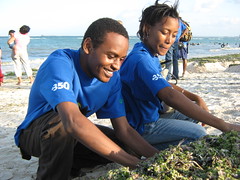
[Photo credit: 350.org action on the beach of Dar es Salaam, Tanzania (CC).]