
Vested interests in the coal, oil, and gas industry would likely characterize such a voyage as quixotic, and they would be correct in one sense: I saw some windmills along the way, each one representing a different phase in America's energy history—Past, Future, and Present.
Windmill 1: The first type of windmill I encountered was actually a windpump. The old beast was motionless and looked something like this:

Alexis Madrigal of The Atlantic has a great chapter in his book, Powering the Dream: The History and Promise of Green Technology, on how innovative businesses and American DIY culture combined to dot the Great Plains with these pumps, making settlement and agriculture possible in arid regions. The technology is still incredibly useful, but it symbolizes the Past.
Windmill 2: The second creature I spied was perched on an Amish rooftop, spinning madly, and looked a bit like this sleek species:
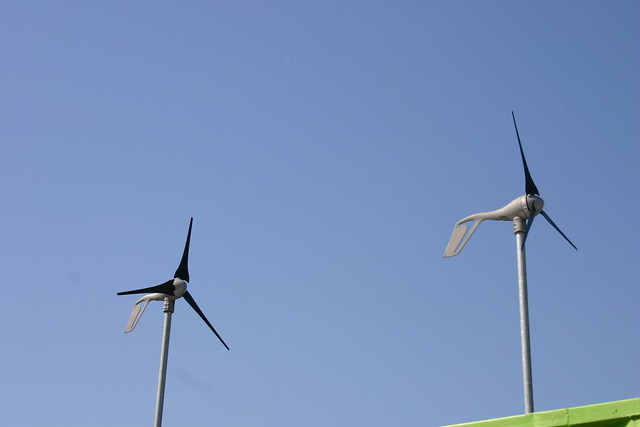
As Kevin Kelly notes in his tome What Technology Wants, the Amish are not adverse to technology as long as it doesn't distort their cultural ethics. They even have social procedures for testing and evaluating new devices, and abandoning them if they are deemed inappropriate. Small modern wind turbines thus symbolize a possible energy Future where innovation is encouraged.
Windmill 3: Finally, I encountered this monster in Morgantown, PA:
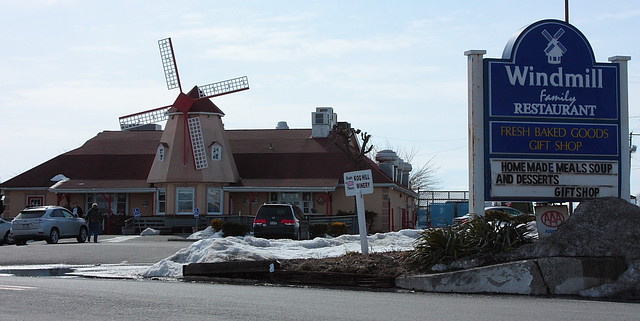
I didn't go rooting through the restaurant's trash to find its electricity bill, but the probability is high that this decorative windmill is powered mostly by dirty coal, as Pennsylvania represents 5.3 percent of America's annual coal consumption. This windmill symbolizes the profligate Present.
I bring this up because a consortium of partners has just launched an innovative initiative to label organizations and products as "WindMade." It is a new chapter in what my colleague Michael Conroy calls the certification revolution, one of the primary forces driving branded companies to improve their environmental, social, and governance indicators. It also builds on the legacy of other "trustmarks" such as Fair Trade, Organic, Forest Stewardship, and Marine Stewardship.
In order to qualify for WindMade certification an organization will have to prove that it is getting at least 25 percent of its electricity from wind power. This can be accomplished via on-site turbines, long-term power purchase agreements, and renewable energy credits. The WindMade standard will roll out later this year, starting with certification of whole organizations and specific locations such as factories, while phase two will expand the process to include product certification.
In an innovative crowd-sourcing move, WindMade has opened up its technical standard for a 60-day public comment period to solicit feedback and advice on how it can be improved.
The primary sponsor of this project is the Danish wind company Vestas, the world's leading turbine manufacturer. Vestas has agreed to fund WindMade as an independent nonprofit for its first three years, and going forward support is expected from all partners as well as the participating companies. When asked at a press briefing whether compliance costs would discourage adoption, Vestas representative Bragi Fjalldal indicated that the expense would be "negligible," especially for carbon-conscious companies that are already monitoring emissions.
Bloomberg is the data partner in this endeavor, providing market research, and Curtis Ravenel of their sustainability group estimated that some 100 companies would already qualify at the 25 percent level.
Clearly Vestas has a business interest in promoting wind power through a labeling system, but they also recognize that wind will never provide all of the world's energy needs. For this reason an alternate WindMade label will be available to companies that want to express the mix of energy they receive from wind, hydro, solar, and geothermal sources.
Another key stakeholder and participant in the WindMade process is WWF. According to Stephan Singer of their global energy policy division, climate change is the single gravest threat to species worldwide, which is why WWF has made the case that it is possible and necessary to achieve 100 percent renewable energy by 2050.
Another positive aspect of the WindMade project is that it intends to aid renewable energy deployment in the developing world. The exact details have yet to be determined, but Angelika Pullen of the Global Wind Energy Council said the following:
WindMade is a global initiative and will reach out to companies in other significant markets such as India, China, and Brazil in the public consultation process to determine how emerging markets and developing countries can best be included in the program. Overall, WindMade strives to make an impact beyond countries where wind energy is well established. It is our intention to raise funds to catalyze wind power projects in countries with less developed renewable energy infrastructure. This is a longer-term goal, however, so the details of how this will be operationalized are still under development.
Complaints about wind being an intermittent power source always strike me as odd, as if that's somehow a fundamentally worse problem than global warming or gyrations in the oil market. The greatest inconsistency I see has been in U.S. policy, which periodically allows wind investment incentives to lapse.
Whether climate change is to blame or not, the world is getting windier, and perhaps this will accelerate construction of offshore installations, which should be competitive with natural gas within the decade. Solar, too, is approaching or has reached grid parity in the sunniest locations.
With its potential to incentivize the growth of renewable energy—which is far from certain at this early stage, given the somewhat "mythical" nature of the ethical consumer—the WindMade label is an innovation that deserves the old "Amish" test run, and early adopters will likely reap a reputational benefit. The success of the program depends upon a strong and transparent technical standard immune from greenwash, which is what makes the public comment period so important. If you have your two cents, now is the time to deposit them.


 Posts
Posts


