Showing posts with label trade. Show all posts

Wednesday, November 24, 2010

Introducing: More Like This

Policy Innovations is pleased to announce the debut of "More Like This," a new article series by our friend John Haffner. John will be profiling clean energy leaders and other green innovators in China over the next several months.

As you can read in his introduction to the series, the motivation is triple: 1. Give these pioneers some of the recognition they deserve; 2. Convey the flavor of life in contemporary China; and 3. Inspire similar leadership in others.

The first article is a frank discussion with Kongjian Yu, an award-winning landscape architect whose designs strive to incorporate energy efficiency and natural beauty.

Yu feels that China's rapid urbanization suffers from what he calls the "'little feet' aesthetic"—showcase buildings built on shaky conceptual foundations. "These ornamental buildings can't carry their own weight. We have little feet but a jumbo body of consumption and GDP growth. Chinese have this dream of being urbanized. But the buildings aren't green."

Also of note on U.S.-China relations is our coverage of "Rare Earths Diplomacy" by Sean Daly. He looks at what we should expect in the rare minerals market and how it could impact production of the wind turbines and hybrid cars we associate with a clean technology economy.

Enjoy, and have a great Thanksgiving.

Friday, June 18, 2010

The Hypocrisy Clause

Guest post by Timothy A. Wise of TripleCrisis

Trade officials in the Obama Administration have made it abundantly clear that they will move forward in the WTO's Doha Round of negotiations only if the larger developing countries agree to open their economies more to U.S. exports. As Kevin Gallagher pointed out on the Triple Crisis Blog ("Obama's New Trade Agenda"), the administration's trade policies, and its announced goal of doubling U.S. exports, backtrack from those of the Bush Administration, renege on the basic principles of the Doha Development Round, and undermine precisely the kind of multilateralism President Obama claims to stand for.

Such intransigence does not bode well for the WTO, nor does it give much hope that the Obama Administration will use the current TransPacific Partnership negotiations to forge what it promises will be a "21st century trade agreement."

Clearly, a creative new approach is needed to break the trade deadlocks. I offer a modest proposal here: Instead of negotiating reductions in tariffs and farm subsidies, it's time to negotiate reductions in hypocrisy. I call it the Hypocrisy Clause, which mandates phased reductions in "trade-distorting hypocrisy," with the greatest reductions coming from the most developed hypocrites.

Why focus on hypocrisy? Ask the unemployed workers who voted for Obama based on his campaign commitment to reform NAFTA and future trade agreements.

Ask any developing country negotiator. Ask the Brazilians, who have been waiting six years for the U.S. government to respect the WTO ruling that U.S. cotton subsidies violate WTO rules. The U.S. has flaunted the WTO finding, appealing twice (and losing), and now Obama's trade officials have the gall say they'll step up enforcement of existing trade rules. They even cut a side deal with Brazil to stave off Brazil's approved retaliatory trade measures, further delaying compliance with WTO rules. Meanwhile, Mexico waits for its NAFTA partner to comply with the NAFTA ruling on Mexican trucks entering the U.S.

But if you want to know why we should negotiate hypocrisy reductions, ask the so-called "Cotton 4" countries in Africa. Their cotton farmers have suffered more than Brazil's from the U.S failure to respect the WTO ruling. Now they listen as U.S. negotiators insist that no movement on cotton can occur until the larger Doha agreement is signed, in direct contradiction of the 2005 Hong Kong commitments to treat cotton "ambitiously, expeditiously and specifically" ahead of the broader Doha agreement.

Who cares what the rules are or what the negotiators agree to if the rich countries then just do what they want?

Under my Hypocrisy Clause, that stops. The United States, as a developed country that has benefited greatly over many years from its past hypocrisy, would have to eliminate such actions immediately. So would the European Union, whose own hypocrisy may not compare with current U.S. levels (much to the EU's delight) but still offers large trade-distorting benefits. The EU could start by scaling back its export subsidies for dairy products, which it raised last year to dump surplus milk despite its loudly proclaimed commitment to end all export subsidies under Doha.

Under the proposed Hypocrisy Clause, rich countries will have to reduce or eliminate "trade-distorting hypocrisy." Hypocritical acts and negotiating positions deemed non-trade-distorting will still be permitted. (Otherwise there would be no politicians to negotiate.)

But what about middle-income hypocrisy? Isn't Brazil one of the world's largest agro-export powers with a well-cultivated reputation for defending the interests of other countries' small-scale farmers? Isn't Brazil also guilty of hypocrisy? Absolutely. In fact, as part of its side agreement on cotton with the United States, Brazil got a multi-million dollar fund for investment in its cotton sector. Talk about hypocrisy: Africa's Cotton 4 will now have to compete in global markets not only with subsidized U.S. cotton but with Brazilian cotton subsidized by the United States!

Middle-income countries such as Brazil, which have only recently begun to benefit economically from their hypocrisy in international negotiations, will have to reduce such trade-distorting actions, but they will be given more time. This reflects the Doha principle of "special and differentiated treatment" for developing countries, with reduction schedules that demand "less than full reciprocity" from developing country hypocrites.

And the Least Developed Countries? Their governments will be allowed to be as hypocritical as they want, since their countries have yet to benefit economically from such positions.

Does my Hypocrisy Clause proposal stand any chance of success, given the rampant hypocrisy in global trade negotiations? It has at least as good a chance as the current efforts to negotiate fair tariff and subsidy reductions when the world's largest trading partner won't respect the Doha mandate, doesn't comply with existing WTO rulings, and demands further liberalization in developing countries' financial sectors after its own deregulated financial sector nearly provoked a global depression.

If rich countries are going to keep using trade negotiations to "kick away the ladder" of development, outlawing the very trade measures they themselves relied on to grow, then we're better off abandoning the pretense of negotiating about industrial tariffs, agricultural subsidies, and service-sector liberalization.

Instead, let's cut the hypocrisy.

[PHOTO CREDIT: Harvesting cotton in Brazil, by Farming Matters (CC).]

Friday, January 29, 2010

ACDC 2010 Call for Papers

Fourth Annual Conference on Development and Change
Johannesburg, South Africa, April 9–11, 2010

Conference Theme
The world economy is currently in the throes of a global economic crisis reminiscent of the great depressions of the 1930s and possibly that of the 1870s. As back then, the crisis resulted from major structural imbalances in financial and credit markets ultimately resulting in a retreat from free trade. Emergent debates about resurgent protectionism, alternative reserve currencies, stimulus packages and climate change policies suggests that the world economy has entered a phase of heightened change which will transform the development "equation" in varied and diverse ways. It is imperative at this time that development economists should engage with two crucial questions: the implications of these changes for the developing world and the prospects for "development" for the majority of people in the developing world.

The forthcoming conference invites submission of academic papers representing original and critical research focusing on the various aspects of the current global economic crisis. Papers are encouraged to employ historical and comparative perspectives where possible, on the impact of the current global financial and trade crises and its impact on the economic performance of developing countries. A focus on policy relevance and prescriptions for developing countries is highly recommended.

Contact conference director Ashwini Deshpande or visit Policy Innovations to download the full details. The deadline has been extended to February 10, 2010.

Friday, October 30, 2009

Stimulus, Justice, and Business in Greening the Developing World

I attended a business leaders luncheon last week organized by the United Nations Association around the idea of Greening the Developing World: Tech's Leading Role (Siemens and TIME co-sponsored). Among the themes one stood out: "Experiment on us!" This came from Minister Modest Mero of Tanzania. He indicated that Africa is an investment opportunity where clean energy pilot projects can take root because they don't have to fight the inertia of creative destruction common in rich countries.

But what is the policy and political landscape for greening development? Robert Orr, the Assistant Secretary-General for Strategic Planning and Policy Coordination, explained the relevance and success of the Clean Development Mechanism in this area. About half of new energy demand and development will be in poorer countries, he said, where 2 billion people live without modern energy access or technology. About one-third of CDM projects to date have involved technology dissemination to these countries.

Orr also made the point that it might be more useful to speak generally of "technology dissemination" instead of "technology transfer." He described the latter as too much of a 1960s–70s term. Recasting the process in this light would help account for co-development, PPPs, and other projects. (While I understand his pragmatic bent here, it does seem to gloss over the justice questions at stake in climate change.)

The CDM for all its faults [PDF] is not an insignificant pool of resources, and lessons have been learned from early implementation efforts. In 2006 some $25 billion was dedicated to projects in the CDM pipeline, $5.7 billion of which went to renewable energy and energy efficiency. But it should have come as no surprise for the UN to learn that money has flowed to the biggest, most profitable projects. As Orr acknowledged, about 80 percent of the projects have occurred in just five countries: Brazil, India, China, Mexico, and the Republic of Korea. Forty-nine other countries account for only 1.5 percent of CDM projects, showing a great need for equity and capacity-building. Orr explained that the UN role should be to help harness the power of the market in a formula that ensures full participation for access to energy.

On the topic of climate ethics, Ambassador Hardeep Singh Puri of India was asked to explain why the West should help countries like India that are its industrial competitors. He answered that you can't solve global climate change without them! He also offered a somewhat rhetorical question of his own: Should the West give to the poorest countries but not to India? Puri estimated that there are more people living in India at the poverty level of the Least Developed Countries than there are total people living in those LDCs.

He said that countries like India offer potential not only as laboratories for new clean energy projects, but also as new markets for green technologies. He stressed that these investments should occur within the existing intellectual property regime (a point also expressed in Sen. John Kerry's Clean Energy Jobs and American Power Act [PDF]). "Accessing technologies" would mean paying for patents, but at affordable rates to promote dissemination of clean technologies. Relying on philanthropy and altruism will go nowhere, he said.

Puri cited renewables and even nuclear as the green technology needs of India, since India still relies heavily on fossil fuels. Biofuels are a non-starter for India in the short and medium term because of land and water shortages, concerns about food security, and commodity price volatility. Puri instead would like to see an increase in public-funded R&D projects that can lead to technology dissemination that also maximizes the common good.

Glenn Prickett of Conservation International broke implementation goals down into three priorities: Efficiency, Forest conservation, and Renewable energy. He cited a McKinsey study [PDF] showing that progress in those areas could account for 75 percent of the global emissions reductions needed by 2020, at a net savings of $14 billion! Of course, this would entail a 50 percent reduction in tropical deforestation, and one roadblock is that public investment in forestry, agriculture, and land-use policies has been dropping.

Energy efficiency solutions, according to Prickett, can be driven by effective standards backed by institutions for enforcement. He pointed out that one of the best ways an "awakening" private sector can contribute is through supply-chain analysis and waste reduction. On a related note, the Kerry climate bill also calls for a voluntary "national product carbon disclosure program," to be based on a review of existing and planned standards such as Carbon Trust's Publicly Available Specification 2050, standards to be developed by the World Resources Institute and the World Business Council for Sustainable Development, and those of the International Standards Organization.

A question was posed to the panel about why the interaction of climate change and land-use issues has been neglected relative to renewables and other investments. Orr responded that food security must be tackled in tandem with climate change, and that technology transfer for adaptation projects that deal with land use could yield huge advances at low cost. Ambassador Puri turned to the case of India, where he said 60 percent of the country lives in rural areas but only 20 percent of the country's GDP comes from agricultural investments. Why the underinvestment? Subsidies in the rich countries! Puri indicated that it's impossible to disentangle climate solutions from the inequities and stagnation of other negotiations such as the WTO Doha Round.

Indeed it is these systemic complexities and inequities that most plague the path to agreement in Copenhagen. But there is nonetheless climate solidarity that transcends national barriers, as evidenced by the massive global call to action organized by 350.org on October 24. As I wrote recently, solving climate change has great potential to serve as an organizing principle for Green Diplomacy, in a way that solves geostrategic, security, and development concerns. But it also has the potential to be a Global Green Stimulus, at a time when developing countries have been further battered by the financial failures of rich nations. Administering much of this stimulus in the form of mitigation grants or an adaptation fund is key to answering the major questions of global environmental justice.

[Photo credit: 350.org action on the beach of Dar es Salaam, Tanzania (CC).]

Friday, April 17, 2009

Alas, We Are Not All Keynesians Now

Policy Innovations contributor Susan Aaronson suggests that the G-20 can use trade and labor policy coherence to fight the global economic downturn, especially its effect on developing countries (Originally posted on VoxEU.org):

The most famous economist of the 20th century, John Maynard Keynes, had an evocative image of capitalism. He once said that markets were propelled by animal spirits. These spirits could yield growth, but at times they must be domesticated to ensure that the law of the jungle—eat or be eaten—does not apply. As markets run wild, policymakers must work at both the national and international levels.

Keynes was particularly concerned with how these animal spirits might affect workers. His views were colored by the massive unemployment he saw during the Great Depression. Keynes feared a "senseless international competition" for jobs. He wanted "new and better arrangements" to link trade and employment. These views influenced the international economic architecture.

After years of negotiation, policymakers agreed to new and better arrangements, as stated in the preamble of the General Agreement on Tariffs and Trade (GATT), which governed trade from 1948–1995, and its successor organization, the World Trade Organization (WTO). Both affirm the parties recognize "that their relations in the field of trade and economic endeavour should be conducted with a view to raising standards of living, ensuring full employment and a large and steadily growing volume of real income and effective demand."

Thus, the members of the GATT and WTO posited trade could create a virtuous circle: By regulating protectionism, trade would expand. Firms could achieve economic efficiencies—producing more goods and services at lower costs. More people would have jobs, access to new opportunities, and ultimately see improvements in economic welfare. By collaborating to regulate protection, the signatories could ensure that trade works for more workers.

However, as the world confronts the worst downturn since the Great Depression, the idea that expanded trade will create and maintain jobs is losing support. The World Bank has forecast that in 2009 global industrial production could decline by 15 percent and world trade may record its largest decline in 80 years. Policymakers have not yet devised effective multilateral responses. Most countries have adopted a wide range of domestic strategies including domestic stimuli; make-work programs; buy-local policies; and sector-specific subsidies. After examining these strategies, last month the WTO found "limited evidence" that its members were adopting trade-distorting measures.

However, while such strategies may not be protectionist in intent, they are not internationalist in their ends. Few policymakers appear to have considered how these strategies designed to restore domestic employment and growth might affect conditions abroad. Because they have eschewed collaboration, the fabric between global trade and national employment is increasingly frayed.

In 2008, for the first time, the WTO and the International Labor Organization partnered to examine the relationship between trade and national employment. The two organizations recommended that national policymakers find ways to make their trade and labor policies more coherent. They also suggested that policymakers could focus on their own citizens' employment needs and act to help developing countries job markets and policies. Many developing countries don't have the funds or capacity to provide such services. But the report suggested no incentives to make such strategies a reality.

So here is a suggestion. The world's largest economies (which include developed and industrialized countries) met in London. These members of the G-20 should consider a two-pronged approach to expanding trade and increasing employment. As evidence of their commitment to multilateralism, these countries should go beyond their pretty words about the Doha Round and commit funds to help developing countries build a social safety net for their workers, and establish programs for lifetime learning.

Along with this incentive, these countries should agree to (and ask other WTO nations) to adopt a "no standards lowering clause." With such a clause, members agree that they will not attempt to attract or maintain investment by lowering labor (or other standards) in the interest of maintaining jobs. Such a clause is consistent with a key objective of the WTO: to increase market access. Governments can distort market access when they change the rules governing markets. 1

In addition, the WTO should disclose (on a public website) which countries are adopting trade-distorting policies, discuss the specific policies these countries have adopted, and encourage scholars to examine how these policies might affect national and international employment. Such transparency can also play an important role in making global markets more efficient and more equitable. 2

Some have argued that, because so many governments have adopted Keynesian solutions to the downturn, "We are all Keynesians now." But we are not truly Keynesian unless we are willing to find global strategies that expand trade and stimulate employment at home and abroad.

Susan Ariel Aaronson is Research Associate Professor and 2009 Policy Research Scholar at the George Washington University.

1. Kyle Bagwell; Petros C. Mavroidis and Robert W. Staiger, "It's a question of market access," American Journal of International Law, 96, No. 1 (Jan. 2002), 56–76.

2. Susan Ariel Aaronson and Jamie M. Zimmerman, Trade Imbalance: The Struggle to Weigh Human Rights in Trade Policymaking (Cambridge: 2007), Conclusion, 186–207.

Thursday, April 2, 2009

South Centre Statement on the Impact of Economic Crisis on Developing Countries

South Centre Executive Director Martin Khor made the following statement (3/25) to a special UN General Assembly dialogue on the world financial and economic crisis and its impact on development:

1. The extraordinarily serious global economic crisis has its origins in the developed countries. Developing countries are not responsible, but they are severely affected, and in ways that are worse than the developed countries, as they also lack the means to counter the effects.

2. Developing countries are only in the past few months beginning to feel the effects of the crisis, due to the lag time in transmission. The crisis will certainly last longer than originally expected, and then it may take even more time before a full recovery.

3. There is thus growing anxiety in the developing world. When he met the British Prime Minister Mr. Gordon Brown, last week, as part of the preparation for the G20 Summit, the Ethiopian Prime Minister Mr. Meles Zenawi warned that African countries could face political chaos if the recession hits at full force. In developed countries such as Britain, the worst problem being faced in the downturn was unemployment. But in Africa, the recession means that "people who were getting some food would cease to get it and instead of being unemployed they would die", said Mr. Zenawi, as quoted in the Financial Times.

4. The developing countries are being hit through two transmission levels—trade and finance. The first transmission channel is through trade. There has been a sudden and steep fall in manufacturing exports, the fall being 30 to 50 percent in many Asian countries. Then there is the fall in demand, prices and export earnings for commodities, affecting especially low-income commodity-dependent countries. On 17 March, The Economist's commodity-price dollar index for all items had fallen by 40 percent compared to a year ago (with declines of 29 percent for food, 44 percent for non-food agriculture products and 56 percent for metals). Earnings from services are also falling, for example in tourism (in the Caribbean tourist arrivals are expected to fall by one third this season) and migrant workers' remittances (a 6 percent drop is estimated by the World Bank for 2009).

5. The second transmission channel is through finance. There is a rapid decline of bank loans to developing countries, whose companies may find it difficult to roll the many hundreds of billions of dollars of foreign loans due this year. There is a reversal of portfolio investment into developing countries, from large inflows in recent years to a sudden huge exit. Net capital flows to emerging markets fell from $929 billion in 2007 to $466 billion in 2008 and will fall further to $165 billion in 2009, according to the estimates by Institute of International Finance. Even FDI is rapidly slowing down because of difficulties in access to credit and economic contraction. If the past record is a guide, aid flows can also be seriously affected in the near future. Trade financing has also been affected by risk aversion, and is choking trade flows; a shortfall of $25 billion in trade financing was reported at a recent WTO meeting.

6. These trade and financial shocks are leading to stresses on the overall balance of payments, with a fall in foreign reserves, and a depreciation of the local currency in some countries. All these together threaten developing countries' ability to service their external debt and avoid a debt default situation. There are already 10 countries that have had to go to the IMF for emergency loans and many other countries are likely to be lining up in the near future.

7. All of the above are causing a stress on the real economy, with declines in GNP and industrial output, a reversal in poverty eradication and a slowdown in social development, as governments face reduced revenues and budgetary stress. Most developing countries are constrained from taking the fiscal expansion measures similar to those of developed countries.

8. There is a need for developing countries to examine the options for national policy on each aspect of the economic crisis and to seek the appropriate policies. However, only some policy measures can be taken at national level, especially if the country is too small to rely on the boosting of domestic-led growth. Regional-level measures are important. And most critical are the reforms, actions and cooperative measures required at the international level.

9. The South Centre views the two issues of reform international actions needed to counter the recession from the perspective of the problems and interests of the developing countries. What are the priority issues for the developing countries, on which action is urgently required?

10. Among the priorities for the South are (1) establishing an international system that fosters financial stability for developing countries; (2) having access to adequate and stable financial resources, as private flows and exports decline; (3) avoidance of financial and debt crises and proper management of crises if they occur; (4) unimpaired access to markets for goods and services; (5) avoiding collateral damage from policies taken by developed countries in response to the crisis; (6) formulating policies for the short and long term for recovery and development, and being able to maintain and expand policy space to implement these policies.

11. There is need to review and reform the international financial and economic systems to ensure the problems that led to the crisis are not repeated and that the international system does not prevent but positively encourages developing countries to have the adequate policy space to deal with the crisis nationally.

12. There are dangers that some crisis measures taken by developed countries may have adverse effects on the South, and thus a need to prevent or offset these actions. For example, developed countries' agriculture subsidies used to be the main distortion in world trade but these are now accompanied by huge subsidies to financial institutions and emerging subsidies to manufacturing (the auto industry). Developing countries lack funds to match these subsidies; they should be allowed to take measures to prevent subsidized service providers like banks and subsidized goods from overwhelming their domestic markets. In the area of tariffs, developing countries should be allowed to exercise their right to use the policy space to raise their applied tariff if it is below the bound tariff. A moratorium against raising applied tariffs would be imbalanced because there is little difference between the applied and bound rates in developed countries, unlike the developing countries.

13. Private investors and public agencies in some developing countries invested in or lent to private and public institutions in developed countries. Developed countries' governments should assure that the assets of developing countries are protected. Pressures from interest groups that exclude developing countries' assets or loans from bailout plans (for example, the suggestion that AIG should only honor claims from nationally owned institutions) should be resisted.

14. New forms of trade protection that affect developing countries should not be introduced. The fiscal stimulus programs should not exclude goods and services from developing countries, as has happened with the Buy American clause in the recent US stimulus package. Developed countries are mainly exempted from the clause due to their membership of the WTO plurilateral procurement agreement, of which most developing countries are not members. There is also need to guard against a new trade protectionist element being proposed in the climate policies and legislation of some developed countries; if this is introduced, it could have a further adverse effect on developing countries' exports and add more stress in this crisis period.

15. A high priority for developing countries is to establish international measures to foster financial stability and avoid activities driven by speculation. The crisis originated from banking deregulation and excessive liquidity creation, causing speculation to be rife in capital and currency markets. Developing countries have been hit by these speculative activities leading to violent fluctuations in capital flows. But because of highly costly self-insurance taken in large stock of reserves, these swings have not created the kind of dislocations seen in 1997 in Asia. An important part of the solution is to reinstall firewalls and regulations to avoid speculative capital flows unrelated to real economic activities (trade and investment) and to establish a system of currency exchange where currency rates reflect underlying fundamentals. This should be a major priority in the reform of the international financial architecture.

16. In the absence of reform and an international system regulating these flows, developing countries must have the policy space and be allowed to undertake national policy measures to regulate capital flows and to defend themselves from speculation. However the required policy space to take the required measures is hindered by (1) IMF-World Bank conditionality that mandates an open capital account; (2) Many North-South free trade agreements that (a) mandate the free and unregulated inflow and outflow of funds; (b) liberalization of financial services, including the entry of foreign institutions for "new financial instruments;" (c) liberalization and deregulation of investments. These barriers (the loan conditionality and the FTA provisions) to the required regulation should be reviewed. Existing FTAs should be reviewed to consider amending clauses that prevent the required regulation. Current negotiations on FTAs such as the EPAs between the EU and the African and Pacific countries should fully take this into account.

17. A major plank of the new financial architecture is the reform of the IMF. Its policy conditionalities have previously not been appropriate in assisting developing countries deal with crises. These include: (1) the policy of an open capital account system, that deregulates capital flows (increasing financial vulnerability) and discourages or prevents capital controls over inflows and outflows; (2) pro-cyclical monetary and fiscal policies that have magnified contractionary conditions; (3) trade policy linked to extreme liberalization of imports and industrial policy based on non-state intervention, which have damaged domestic agriculture and industry in many developing countries. A preliminary review of recent crisis loans to 10 countries (including some developing countries) by the IMF show that contractionary financial and fiscal policies (such as a significant increase in interest rates, and a reduction of government spending) are still maintained as part of the loan conditions.

18. A reform of the IMF is thus crucial. Without the reform, it is premature to expand its resources. The IMF should not impose or promote an open capital account or prevent regulation of capital flows. It should not deal with trade and industrial policies and other development-related policies. The reform process should lead to its creditor role being confined to providing short-term loans to countries to deal with temporary balance of payments difficulties. In that area, its policies should be counter-cyclical and not pro-cyclical. Countries should not be requested to provide loans to the IMF to augment its resources because this would compromise the ability of the IMF to carry out its surveillance function and to discipline the policies of countries that provide the loans. It can obtain resources from the market or from the issuance of SDRs, instead of obtaining loans from governments. The imbalances in the system of governance, with its present serious imbalance in voting rights and decision-making, should also be addressed.

19. One major source of financial instability is that the international reserve currency is the currency of a single country (the United States). This causes instability as availability of reserves for the world economy depends on the reserve currency country (the US) having growing current account deficits. This problem is worsened under the present crisis because of: (a) the absence of multilateral discipline over exchange rate and macroeconomic policies of the US; (b) developing countries' increased vulnerability to fluctuations in capital flows and exchange rates; (c) pro-cyclical behavior of financial markets; (d) developing countries holding large stocks of foreign reserves at very high costs. As an alternative, an international reserves system based on the SDRs could be established. The IMF could distribute SDRs to itself to make it available to members, and there should be greater automaticity in access to it.

20. The new financial architecture should include establishment of a multilateral fund or funds. This could be similar to the two oil facilities set up in the 1970s to assist countries cope with the oil price increases and to prevent a global recession. The fund can assist developing countries counter the recession and to offset the multiple losses of financing caused by reduced exports, migrant remittances, service payments, loans, investments, trade financing, etc. The shortfall facing developing countries may total many hundreds of billions of dollars a year. The fund should thus be of a major amount. The channels of funding and its multiple uses should be determined together by the international community.

21. Developing countries should also be encouraged to explore and expand regional financial cooperation. Examples of this are the Chiang Mai Initiative and its extension in Asia, and the Bank of the South in Latin America.

22. The new financial architecture should also deal with the threat of new debt crises facing developing countries. The current account and overall balance of payments of many developing countries and their foreign reserves are or will be coming under increasing stress, due to a crisis that was not of their doing. The reform process should establish as a priority an international system of debt standstill and debt workout for countries that face debt servicing difficulties. Proposals on this (which originated at UNCTAD) had been rather extensively discussed, including at the IMF, but did not lead to any conclusions. Given the present crisis, this should again be a priority proposal. A new round of debt elimination and debt relief should also be looked at now.

23. For many of the poorer countries, dependence on commodities has revived as a serious problem because the positive conditions and high prices of the past several years have vanished. The stabilization of commodity prices and fair remuneration to producing countries has thus become a priority crisis issue for developing countries. International cooperation on resolving commodity issues should thus be on the reform agenda.

24. The crisis provides an opportunity to address the deficits and imbalances in the governance of global finance and economic issues. The United Nations used to play a central role in policy formulation and in reaching and implementing agreements. However in recent years, too much faith and power had been given instead to the markets and to international financial institutions which supported the drive towards "marketization" and "financialization." At the national level, in developed countries in the centre of the storm, the pendulum has swung, with the leadership and interventionist role of the state being emphasized. The international counterpart of this national-level development should be the strengthening of the role of the United Nations, including its General Assembly and its economic arms, particularly ECOSOC. Greater authority provided to a strengthened and more effective UN should be a crucial element of the new global economic architecture.

25. The UN General Assembly high-level conference in June is an important opportunity for discussion and follow-up actions on the wide range of issues of the crisis and how it affects development, and the remedies required. The South Centre is willing to contribute to the success of this very important event.

Monday, February 9, 2009

The "D" Word: Deglobalization

Once described as inevitable, unstoppable, and irreversible, the great economic experiment with global integration is faltering.

Before we go any further, let's be clear about something. Globalization has been declared dead before. But in the past, those peddling reports of its demise seemed just a little too eager, barely able to conceal their glee. And, of course, they were never quite able to produce the body.

This time, things are different. There are bodies everywhere. This time nobody's smiling.

Financial Times editor Martin Wolf described the mood at January's meeting of the World Economic Forum in Davos, Switzerland as "gloom verging on despair." British Prime Minister Gordon Brown warned recently that the global economy was in a "downward spiral."

These are not the voices of protest. Wolf is the author of a 2004 book titled Why Globalization Works. Brown has called globalization "a force for good." This is about as far away as you get from the anti-globalization crowd that regularly shows up to demonstrate at meetings of international financial institutions such as the World Bank, the IMF, and the WTO.

In normal times, these are voices that exemplify sobriety. These are not normal times. Brown even uttered the "D" word – depression – a word placed off limits by economists long ago out of fear that its mere use would spread unnecessary fear and minimize the collective global misery of the 1930s.

There is, however, another "D" word looming out there, one so clunky and unappealing that it is unlikely ever to end up in the title of a best-seller: Deglobalization.

When people think of globalization, they often think in terms of "flows" – trade flows, investment flows, immigration flows. This is a useful way of looking at it, because it provides an easy measure of globalization's progress at any given time. The greater the flows the more integrated the global economy has become. Over the last few decades the progress has all been in one direction.

Those days are gone. Trade flows have begun to drop off. Foreign direct investment has been declining for the last two years and is projected to dip even further in 2009.

But deglobalization, like globalization, will not merely be limited to flows of financial capital and manufactured good. It will affect people as well.

In the United Kingdom, a French-owned company's plan to hire Portuguese and Italian contractors rather than British workers recently resulted in a nationwide string of work stoppages. In South Africa, immigrants and refugees from neighboring Zimbabwe have been targets of xenophobic violence.

Economic pain has led members of both U.S. political parties to support "Buy American" and "Hire American" provisions as part of federal stimulus spending.

"The purpose of this program, asking taxpayers to sacrifice, is really not to create jobs in the European Union," Illinois Democrat Dick Durbin, the second highest ranking member of the Senate, told French news agency AFP. "I want to create jobs in Illinois."

“With the unemployment rate at 7.2 percent, there is no need for companies to hire foreign workers … when there are plenty of qualified Americans looking for jobs," added Iowa Republican Chuck Grassley.

With friends suddenly in short supply and serious talk of protectionism in the air, globalization is clearly on the run. But could the American credit and mortgage crises actually force the mighty wave of globalization into reverse?

Why not? It's happened before.

The collapse of the Byzantine Empire destroyed the 2,000 year-old Silk Road and plunged the rich world into a mercantilist scramble for colonies. The global integration of the late 19th century – a time economist John Maynard Keynes called an "extraordinary episode in the economic progress of man" – was undone by the horrors of World War I, resulting in nearly 40 years of beggar-thy-neighbor trade policies and anemic worldwide economic growth rates.

Over the last half century, globalization has had salutary effects on governance, innovation, and prosperity. It is a controversial process, to be sure, but a return to mercantilism seems certain to prolong the current crisis.

The challenge for policy makers will be to resist political pressure to de-globalize. The temptation will be strong, but giving in will not be de-lovely.


Photo Credit: Buy American! by Photo Mojo

Wednesday, May 28, 2008

Compensating the Losers from Trade

I am always happy to see my copy of the National Interest come in the mail. In the latest issue, there is a debate that will surely excite trade specialists between two highly respected economists Joseph Stiglitz and Gary Hufbauer. Stiglitz, an advisor to our program at the Carnegie Council, makes a point that is often forgotten in the trade policy world. There is a bargain implied in trade theory: Since free trade creates some winners and some losers, for free trade policies to be fair and politically sustainable, the winners should compensate the losers. Here is Stiglitz in the National Interest:

More generally, standard economic theory does not say that everyone will be better-off as a result of trade liberalization, only that the winners could compensate the losers. They could take a portion of their gains, give it to the losers and everyone could be better-off. But, of course, the winners, which in much of America are the very well-off, haven’t compensated the losers; indeed, some have been arguing that to compete in the new world of globalization requires cutbacks in government spending, including programs for the poor. The losers then lose doubly.


Stiglitz actually goes on to write that free trade can in some cases make everyone worse off--contrary to trade theory. Free trade can expose people and companies to greater risk, for example.

Policy Innovations has just published Part Two of a trade policy roundtable in which specialists Susan Aaronson, Sherman Katz, Frank Lavin, and Thea Lee debate the future of U.S. commercial policy. Check it out here.

Wednesday, April 16, 2008

Fighting the last war on trade

Once again, trade is in the headlines. As the resident trade hawk on this blog, I cherish the unexpected opportunity to defend the principles of free trade that this presidential campaign season has repeatedly generated.

The economic argument in favor of free trade centers on efficiencies gained through specialization, not on the opportunity for increased political leverage that can be brought to bear on trading partners. Yet, many of trade's harshest critics insist on linking the two. Why? Many of these same critics howl in protest - and rightly so, I think - at the hawkish promotion of democracy through military intervention that has characterized the last several years of U.S. foreign policy. Violence aside, both approaches represent a degree of unwanted meddling in the sovereign affairs of another nation. Both approaches are intended to bring about a positive change in the lives of ordinary citizens. There is an argument to be made that the best thing you can do to help poor people living in less-than-open socities is to trade with them. But it's an economic argument and, therefore, destined to be misunderstood, discounted as a tool of commercial interests or, worse, manipulated to reach an opposite conclusion.

The promise of freer trade can be a useful carrot in a nation's foreign policy toolbox, I'm not denying that. Market access and closer political ties are often strong incentives for targeted domestic reforms in areas such as labor rights, environmental stewardship and civil liberties. Yet, the economic argument in favor of free trade says nothing about these effects. They have been linked to trade over the years by political actors and used to demonize what is essentially a positive aspect of a nation's development: openness.

I am tempted to reprint Robert J. Samuelson's entire column from today's Washington Post. I won't. But the following excerpt makes many of my points for me. Quite frankly, I wish I had written it myself.

...[I]t's politically convenient to oppose the [Colombian free] trade agreement because the popular imagery is that trade destroys U.S. jobs. The loss of almost 4 million U.S. manufacturing jobs since 1998 seems easy to explain by cheap imports or the flight of plants to Mexico, China and other poorer countries. The truth is murkier: Although this has occurred, job losses also stem from greater efficiency (fewer workers producing more goods) and slumping domestic demand (for communications equipment and computers after the dot-com bust and for housing materials and vehicles now). Nor has falling factory employment crippled overall U.S. job creation.

Look at the numbers. From 1998 to 2007, total non-farm payroll employment rose 12 million, and unemployment averaged only 4.9 percent -- despite the 4 million lost factory jobs. In that period, U.S. manufacturing output rose 22 percent.

No matter. Globalization and trade have become lightning rods for myriad grievances (job insecurity, wage inequality, eroding fringe benefits). But even if trade caused all the factory job loss, its impact is shifting. The dollar's dramatic depreciation (down an inflation-adjusted 20 percent since early 2003 against a basket of currencies) has enhanced the competitiveness of U.S. exports. Their growth now looms as a major source of job creation and economic expansion.

You can read Samuelson's whole column here.

Photo by vlauria.

Thursday, February 28, 2008

Hammering NAFTA

In Mexico City yesterday, signatories of the North American Free Trade Agreement (NAFTA) were highly critical of statements made by Democrats Hillary Clinton and Barack Obama during their Tuesday debate indicating they would "opt-out" of the trade pact.

"I will say we will opt out of NAFTA unless we renegotiate," said Clinton.

Obama concurred: "We should use the hammer of a potential opt-out."

But as Michael Luo points out today in The New York Times, despite the harsh rhetoric, the candidates have staked out nuanced positions on NAFTA. Luo quotes David Gergen, an adivser to President Bill Clinton as saying that Senator Clinton was "extremely enthusiastic" about the trade agreement while it was being crafted. As recently as 2004, she claimed that NAFTA had been "good for New York and good for America."

Obama, for his part, while consistently hammering NAFTA, has not differed from Senator Clinton at all when voting in the Senate on trade issues. As Eduardo Porter notes in his article, "Nafta Is a Sweet Deal, So Why Are They So Sour?," the real benefits from a dismantling of the agreement would accrue to powerful industrial and agricultural special interests "who survive behind protective barriers." Specifically, American Big Sugar and Mexican corn farmers.

So why are Clinton and Obama itching to prove just how much more opposed to NAFTA they are then the other guy?

It's Ohio, stupid. The hotly contested state has lost hundreds of thousands of manufacturing jobs in the last five years.
In Ohio, which has lost nearly 225,000 manufacturing jobs since 2001, NAFTA is an easy target. For many working-class Ohioans – and the voters Sens. Barack Obama and Hillary Rodham Clinton hope to win in Tuesday's critical primary – it stands as a symbol for much that troubles their state. Against that backdrop, say experts, it's not surprising it's become a political piñata.

Tuesday, February 12, 2008

Rising food prices to jump start Doha?

As my Carnegie Council colleague Evan O'Neil noted in this space nearly a year ago, "Agriculture ... persists as the millstone around the neck of international trade negotiations, grinding the process to a halt." Now it looks likely that there will soon be movement on the so-called Doha round of trade talks at the WTO and it is agriculture that is providing the spark.

The Wall Street Journal's John W. Miller reports this morning that the European Union's recent temporary elimination of import tariffs on cereal may be the first step toward a restructuring of developed-world subsidies for agriculture (permanent link to story here).
The world's scramble for affordable food is tearing at the patchwork of agricultural tariffs that governments have long used to control trade - and offering a glimmer of hope to those trying to kick-start a stalled global trade deal....So far, the situation hasn't forced a rethinking of subsidies that farmers in the developed world receive. But some say that is an inevitable consequence of higher global food prices.
While rising food prices and crumbling trade barriers may mean good news for farmers in the developing world, there is, of course, the potential for downside. In Policy Innovations recently, Christina Madden pointed out the negative relationship between food prices and food aid.

With food prices in the United States rising at the fastest pace in 17 years, the biggest losers are developing nations. The United States is the world's leading food aid donor, but this year aid was cut to less than half of what it was in 2000. Director-General Jacques Diouf of the United Nations Food and Agriculture Organization cautioned that soaring food prices could make it harder for the international community to meet the Millennium Development Goals of halving extreme poverty and hunger by 2015.

Fundamental tradeoffs such as this are responsible for economics' reputation as the dismal science. It is tempting to think of these things as the economic equivalent of Newton's 3rd law: For every action, there is an equal and opposite reaction. But it is precisely in this that economics diverges from the hard sciences: The opposite reactions are often not equal. In this case, poor farmers in the developing world may be better off, and food-poor populations may be worse off, but it is unlikely that they will be so in equal measure. One group's benefit or loss is likely to be out of proportion to the other. Meaning that the possibility exists for an absolute increase in well-being. Which is, after all, the point.

----
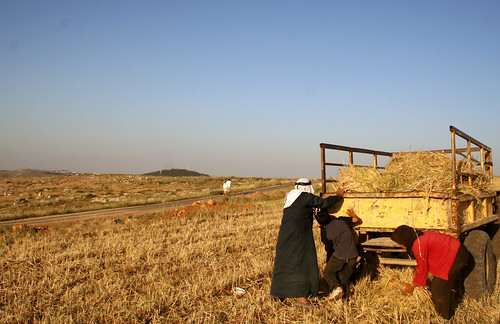
photo of Palestinian wheat farmers by delayed gratification (CC)

Thursday, December 20, 2007

Candidates tiptoe around trade

An unusual story from Bloomberg's Hans Nichols and Julianna Goldman this morning. Unusual how? Well, for starters, it treats trade as a complex issue with wide-ranging, and by no means uniform, consequences.

Democratic presidential hopefuls are tip-toeing around an inconvenient economic fact: Iowa and New Hampshire, the states hosting the 2008 campaign's first contests, benefit from free-trade policies that many residents nonetheless blame for lost jobs. Hillary Clinton, Barack Obama and John Edwards are seeking to avoid alienating workers from agriculture and other export- intensive industries while appealing to those from U.S.-focused businesses that have fallen behind, especially union members.

In the past I have accused presidential candidates from both parties of engaging in "Campaign Protectionism." I have also offered an explanation for the unsettling phenomenon of declining support for free trade in the U.S.. Namely, the benefits are disguised while the costs are highly visible. Opportunistic politicians have often exploited this perception gap to great advantage. Hillary Clinton, especially, has wavered on support for free trade, giving the appearance of a naked play for labor union votes. Along with Obama and Edwards, she opposed the U.S.-South Korea free-trade agreement. Now, in this Bloomberg report, some nuances emerge.

"You have winners and losers from trade,'' New York Senator Clinton said at a Dec. 13 debate in Iowa. People "are gaining because we're exporting,'' she said, while others have lost jobs.

The location of this remark is significant. Support for Edwards is strong in Iowa and he is known as a union favorite. Could this be the beginnings of a navigation back towards the center in anticipation a general election campaign?

Sometimes, as in New Hampshire, trade's 'winners and losers' live side-by-side, making it difficult to tailor the message to the audience. Moreover, the unique juxtaposition of the Iowa caucuses and New Hampshire primaries presents a difficult challenge to a candidate's desire for consistency. Nichols and Goldman cite poll numbers showing the two states are mirror images on free-trade: New Hamphire in favor, Iowa against.

Tuesday, November 27, 2007

Campaign Protectionism

David Brooks offers a strong condemnation in today's New York Times of the current "protectionist drift" characterized by the thinking and prognosticating of Lou Dobbs &c. He has taken to calling this approach Dobbsianism, noting with fear that its popularity is increasing even now, during a period of relative economic well-being. "...you can imagine how attractive it’s going to seem if we enter the serious recession that Larry Summers convincingly and terrifyingly forecasts in yesterday’s Financial Times. If the economy dips as seriously as that, the political climate could shift in ugly ways."

Many of the presidential candidates have moved along with the shifting tide of Dobbsianism. I have begun to think of this as Campaign Protectionism. As Brooks notes, "Their speeches constitute a symphony of woe about lead-painted toys, manipulated currencies and stolen jobs," rather than the increases in living standards and improved environmental standards that globalization fosters. Campaign Protectionism is a cynical tact because it plays on innate fears and ignores empirically verifiable gains from trade.

...not every economic dislocation has been caused by trade and the Chinese. Between 1991 and 2007, the U.S. trade deficit exploded to $818 billion from $31 billion. Yet as Robert Samuelson has pointed out, during that time the U.S. created 28 million jobs and the unemployment rate dipped to 4.6 percent from 6.8 percent.

That’s because, as Robert Lawrence of Harvard and Martin Baily of McKinsey have calculated, 90 percent of manufacturing job losses are due to domestic forces. As companies become more technologically advanced, they shed workers (the Chinese shed 25 million manufacturing jobs between 1994 and 2004).

Paul Krugman is Brooks's colleague at the New York Times and a noted economist in his own right. While the two are rarely in agreement on political issues, they do concur, as Krugman recently told NPR, that politicians should "cool the rhetoric" on globalization.

So do we have to be protectionist to make workers' lives better? No. All the evidence says that you can be a full participant in the global economy while still paying good wages.

Friday, July 6, 2007

Downward Pressure on U.S. Wages - Trade Not All to Blame

Grant Aldonas of CSIS, Matthew Slaughter of Dartmouth, and Robert Lawrence of Harvard recently wrote a report entitled "Succeeding in the Global Economy: A New Policy Agenda for the American Worker" sponsored by the Financial Services Forum. While the report finds that openness and globalization has added more than one trillion dollars annually to U.S. GDP, the debate has been too narrow, unfairly blaming trade for workers' woes. Here is an excerpt:

Since 2000 U.S. corporate profi ts have nearly doubled, from $817.9 billion in 2000 to $1.62 trillion in 2006. This rise has not been concentrated in one particular sector, but rather has been enjoyed quite widely across many industries. As a share of total national income, these corporate profits are today near 60-year highs at about 14 percent. The concentration of equity ownership in America means that higher corporate profitability may have contributed to the just discussed skewness of total-income growth.

To summarize: in recent years the large majority of American workers has seen poor income growth. Indeed, 96.6 percent of Americans are in educational groups whose mean total money earnings have been falling, not rising, since 2000. Only a small share of workers at the very high end has enjoyed strong growth in incomes. The strong U.S. productivity growth of the past several years has not been reflected in wage and salary earnings, and instead has accrued largely to the earnings of very high-end Americans and to corporate profits.

Read the full report here.

Monday, June 4, 2007

Trade-Labor Linkage

Policy Innovations innovators Sanjay Reddy and Christian Barry respond to Jagdish Bhagwati's recent op-ed in the Financial Times, "Foes of free trade get a foot in the door" in which he argues that many of those who want the inclusion of labor standards in trade agreements do so out of fear and self-interest. Bhagwati labels such people as foes of free trade.

Reddy and Barry in this June 2, 2007 letter to the FT remind us that not all proponents of linkage are protectionists. They note that there is another way:

"There is an alternative approach to linkage, which would provide an attractive means of furthering the interests of poorer countries. This alternative would extend the transparent, rule-based approach of the WTO system to include an appropriate concern for labour standards (thereby excluding opportunistic actions by wealthy importing countries). It would require that poorer countries undertake only those efforts to promote labour standards that are reasonable to expect in light of their circumstances; while also ensuring that these countries gain by providing them with additional access to northern markets and other forms of reward for their efforts."

Wednesday, February 21, 2007

Ethical Trading Initiative Too Tight for Levi's

The Ethical Trading Initiative suspended Levi Strauss & Co. because the company has failed to sign ETI's living wage clause. Levi's claims that the concept and its implementation are not properly defined, and that its own code of conduct is "completely actionable."