Thursday, June 7, 2007

Craig Newmark on Digital Social Responsiblity

Craigslist Founder Craig Newmark (his blog cnewmark is here) just finished speaking on "Digital Social Responsibility: Searching for Ethics on the Internet" this afternoon at the Japan Society in New York City. Dan Rosenblum and his team at the Japan Society put together this event as part of their corporate program's Tech Epoch series. New York Times correspondent Brad Stone was moderating. Policy Innovations got to listen to Newmark's insightful comments.

Newmark's main theme was that his business has worked on the basis of shared values, specifically trust, in the U.S. society. The biggest problem at craigslist? "Misinformation gangs" spreading lies about political candidates. The reason this problem is more serious than spamming, housing scams, etc. is because billions of dollars are at stake.

I paraphrase some more of Newmark's highlights here:
  • Craigslist works based on trust and universal values in the U.S.--these are based on Judaism, Christianity, and Islam (Abrahamic religions). It works on the premise that most people treat people the way they would like to be treated. There are few bad guys but they are noisier than their numbers would suggest.
  • The company's moral imperative is to work with the victims of scams and the police to catch the bad guys. But you have to balance this effort with the privacy rights of bad guys. Sometimes we have to operate on an internal moral compass or what "feels right."
  • Jon Stewart and Stephen Colbert are pioneers in speaking truth to power, helping the health of our democracy. Another pioneer is blogger and writer Dan Gillmore. While craigslist is for the now, wikipedia is for the ages--it allows history to be written by all people, not just the victors of history.
  • The Internet started with Johannes Gutenberg and the "blogger" Martin Luther came up with the first killer app. known as the Reformation.
  • While Tim O'Reilly advocates an ethical code of conduct for bloggers, Craig agrees that bloggers should at least disclose their affiliations. (Devin says: I agree with the code that anonymous postings should be avoided. As O'Reilly puts it, "When people are anonymous, they will often let themselves say or do things that they would never do when they are identified.")
  • The Web can help remind us where society is supposed to be going and it can help to expose crimes like corruption. (The Internet can help create a more ethical society.)
  • Not sure what web 3.0 means but it has something to do with collaborative filtering and trustworthiness metrics. Finally, he joked despite its emergence, Craig is disappointed we still don't fly around with jet packs.

Monday, June 4, 2007

Trade-Labor Linkage

Policy Innovations innovators Sanjay Reddy and Christian Barry respond to Jagdish Bhagwati's recent op-ed in the Financial Times, "Foes of free trade get a foot in the door" in which he argues that many of those who want the inclusion of labor standards in trade agreements do so out of fear and self-interest. Bhagwati labels such people as foes of free trade.

Reddy and Barry in this June 2, 2007 letter to the FT remind us that not all proponents of linkage are protectionists. They note that there is another way:

"There is an alternative approach to linkage, which would provide an attractive means of furthering the interests of poorer countries. This alternative would extend the transparent, rule-based approach of the WTO system to include an appropriate concern for labour standards (thereby excluding opportunistic actions by wealthy importing countries). It would require that poorer countries undertake only those efforts to promote labour standards that are reasonable to expect in light of their circumstances; while also ensuring that these countries gain by providing them with additional access to northern markets and other forms of reward for their efforts."

Thursday, May 24, 2007

Lack of Fairness a Globalization Risk

Creating a fairer globalization is not just the right thing to do, it is also a way of making the global economy more stable and sustainable. The Wall Street Journal ran an article on its front page today entitled, "Globalization's Gains Come With a Price--While Poor Benefit, Inequality Feeds A Backlash Overseas."

The piece confirms what we know: Contrary to economists' predictions, globalization is widening the income gap between the rich and poor in many poor countries:

"Globalization deserves credit for helping lift many millions out of poverty and for improving standards of living of low-wage families... But because globalization is also creating more inequality, it is raising questions about how much inequality countries can bear and whether these gaps could ultimately produce a backlash that will undermine trade and investment liberalization around the world."

And therein lies the rub. Lack of fairness is a risk to the current form of globalization. As a result of inequity, populist political candidates have gained ground in Latin America and China worries about social stability. The perfect quote is from Chinese Premier Wen Jiabao last March in which he says his government must "safeguard social fairness and justice and ensure that all of the people share in the fruits of reform and development."

On a related note, when I was in Shanghai last week, I asked a senior think tanker to name the biggest challenge facing Chinese society today. His answer was, "a lack of ethics." The Cultural Revolution left society with a vacuum in social values that is being filled by consumerism today. Corruption, lack of trust, and greed plague China.

It seems the Chinese government is even starting to get religion, literally. He and other Chinese officials have asked me about the positive role religion can play in providing an ethical framework in society. Given the rapidly growing Christian population in rural China, a solution may be in plain sight.

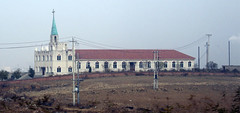
Christian church in China, seen from Shengyang to Harbin bus. Photo by Brian Yap (Creative Commons Attribution-NonCommercial 2.0).

Christian church in China, seen from Shengyang to Harbin bus. Photo by Brian Yap (CC).

Monday, May 21, 2007

"Asia" as Postmodern Experiment

Asia is not Europe.

This statement seems obvious but it is important to remember that it is dangerous to use the framework of European integration to predict Asia's future. I am in Tokyo today, headed back to New York tomorrow morning. One of the themes of my current research trip on ASEAN's relations with China and Japan is that the primary motivation for ASEAN to consolidate its political structure is simply to balance China.

We are witnessing old fashioned balance of power politics in Asia, not necessarily a unified or ambitious vision. Sure, human rights and democracy may make it into the charter ASEAN will negotiate this fall, but to understand where Asia is going is to think about managing chaos without a concrete destination. Many of the people we interviewed in Asia called ASEAN an experiment, with no direction, an experiment that is both the product and manager of power politics.

A few months ago a group of Russian students asked me if we are living in a uni, bi, or multipolar system. I don't think that kind of thinking is helpful anymore.

My answer was that it depends on the question. Russia can be an energy superpower. Think about Syriana, the messy, chaotic story of the globalized energy supply chain: No one is in control; everyone is in control. This understanding of the international system, I have found, is common among those who study globalization and Asia--both of which I follow.

Thursday, May 10, 2007

CSR on the (Elite) Mind in East Asia

I am in the Singapore airport bound for Shanghai, reflecting on my visits to Manila, Jakarta, and Singapore. Three policemen armed with automatic weapons just walked by the free Internet stall to take the escalator downstairs.

I don't want to get carried away, but I am happy to say that issues such as the environment, human rights, and good governance are not confined to conversations in California, Washington DC, New York, Europe, and Japan. Every day, the local newspapers ran at least one article about the environment, climate change, and their popularization in ASEAN.

I read about an eco beauty pageant in Manila and about how Bangkok shut off its lights a couple of days ago to promote eco awareness. On the TV, I saw an ad in Manila (sponsored by the UNDP) against corruption and a music video in Jakarta promoting energy efficient light bulbs. In the cab ride the the airport this morning, the driver spoke about the environmental problems in Southeast Asia broadly, and said that he has never seen such bizarre weather in Singapore. Every businessman, scholar, and government official we interviewed acknowledged the importance of eco and human rights leadership in the world economy.

Now, I don't want to overstate the case. Clearly, the biggest problems facing many countries in ASEAN are poverty and political stability. I understand that I was reading newspapers in English, the TV was in English, our interviewees were elite, and the taxi driver was in fact from a highly educated family. But we should not forget how human rights abuses and environmental degradation can conflate with terrorism, corruption, and instability. The perfect storm could go something like this:

Imagine an area saturated with corruption (which is seen by investors as the number one problem in the Philippines). Officials take bribes from criminals, and gangs are allowed to arm undisturbed by law enforcement. They are able to prosper by engaging in illegal activities such as piracy or smuggling. Lack of equity creates resentment toward more successful groups in the society. An environmental disaster, such as a flood, destroys homes and makes people more receptive or vulnerable to a strongman. Gangs seize the opportunity to overthrow the local government. Martial law is declared, rights are curtailed, foreign direct investment flees, and a downward spiral of poverty and violence ensues.

It isn't that far fetched. All these issues are related.

Singapore's Brand: Technology Leapfrog

A few weeks ago, I was asked to guess when Chinese enterprises would be forced to respect human rights when they did business abroad. My answer was that it depends on the emergence of a brand and its accompanying vulnerability. I read recently that the majority of corporate value is tied up in intangibles such as brands.

Right now, we are seeing the beginnings of "China" as a country brand. Rather than reject UN declarations on human rights and other norms, China has sought to portray itself as an unlikely defender of human rights and shifts the focus on the human rights record of the United States. China is embracing and shaping international institutions, not rejecting them.

My guess is that Chinese enterprises will become more sensitive to human rights issues when recognizable Chinese corporate brands enter the scene. Sure, cheap Chinese cars are making headway in low-end markets. Chinese business standards will improve when customers demand an improvement, including in supply chains.

This week I am in Singapore and I got a detailed explanation of this state's brand a couple of days ago at the Singaporean Chamber of Commerce. Singapore's brand is to be the best environment for foreign direct investment (FDI). Its Economic Development Board uses its international connections and intelligence to identify the Next Big Thing and figures out how to make Singapore an attractive nest for that Thing.

Singapore looks for the top partners on the planet for the projects. In other words, if they want to get high finance, they do not look for the managers of funds, rather they look for the people who advise the managers. The very top.

The Next Big Thing now is water technology, digital media, and biotechnology—Singapore attracted the Dolly guy. A gleeful article in the Straits Times yesterday captures this attitude. The top headline was "US business, political elite upbeat about S'pore: PM," and the piece started out with this:
"America's movers and shakers are upbeat about Singapore and that, to Prime Minister Lee Hsien Loong, is one sign it is doing the right things."

Singapore is doing the "right things"—to leapfrog the region in technology. The other interesting thing is that Singapore draws on national pride to abandon bad projects, instead of holding on and bleeding resources: Think of the Malaysian Proton car. A great strategy, but ASEAN resentment or jealousy toward Singapore is understandable, especially since the common wisdom in the region was that Asian economies would follow an orderly flying-geese pattern of economic development.

Not only has Singapore's success created distrust, the state is too small to lead Asian regionalism. Thailand's leadership prospects have been put on hold by the coup. The Philippine economy is too weak. That leaves Indonesia or possibly Malaysia as candidates.

–Devin Stewart

Saturday, May 5, 2007

A New Day for ASEAN?

I woke up today at dawn to the morning call to prayer in Jakarta.

Carnegie Endowment scholar Joshua Kurlantzick and I are traveling through Manila, Jakarta, and Singapore, asking businesspeople, government officials, journalists, and scholars what China's rise means for the future of ASEAN and business and human rights norms. The subtext is that China and Japan are trying to outdo one another in creating goodwill in this battleground for influence.

The topic of China's relationship with the developing world is very timely. I spoke at the New School's Project Africa program and at Wellesley College on the same subject last month. Kurlantzick also just published a book on China's soft power in Southeast Asia called Charm Offensive, and UCLA scholar Josh Eisenman will be presenting his new book on China and the developing world at the Carnegie Council this May.

In my mind, the question is: What will China's economic weight and activity do to business, environmental, and human rights norms around the world? Particularly since state to state war seems less and less likely in East Asia (or "unthinkable" as ASEAN puts it), rivalry between big powers falls into the more nuanced games of economic diplomacy, investment, institution building, and fighting nontraditional global security threats, such as climate change, pandemics, and piracy.

It could turn out to be a net positive in which China keeps trying to attract markets and business partners in areas previously believed to be the domain of Japan and the United States, such as Indonesia or Philippines. China may also build ties in areas in which the West will not go, such as Sudan. Or the story could end up in nasty rivalries, rampant suspicion, and a virtual cold war. But so far the tone is positive.

ASEAN is courting anyone who will dance—the United States, Japan, and China—in what some call "promiscuous diplomacy." Whether ASEAN can be the hub for a vision that increasingly seems to appreciate the importance of social responsibility at the upper levels will depend on whether ASEAN can become a more coherent, political entity. That in turn will depend on ASEAN resolving major debates on the noninterference principle and on decision-making by voting. It will also mean gluing together the world's largest Muslim democracy with tenacious Communist states, and exemplar market economies.

Whatever the outcome, ASEAN is waking to a new reality.